WAZI Application Specification
Due diligence and supply intelligence platform for gold supply chains, with an artisanal mining focus. Designed and developed by Datastake; current deployment for Mwamba Mining (Tanzania).
1. Context
1.1 The Challenge
Artisanal and small-scale gold mining (ASGM) accounts for a significant share of global gold production, yet its supply chains remain among the least documented and most difficult to assess. Aggregators, exporters, and refiners sourcing from ASGM face a set of interconnected challenges:
Fragmented, informal supply networks. ASGM supply chains are geographically dispersed across many small actors and informal handoff points. Sourcing opportunities surface through personal networks rather than structured procurement. Ownership structures are layered, unclear, or only partially documented.
Reactive, retrospective due diligence. Due diligence is traditionally conducted after the fact: document-based, narrative-heavy, and reliant on third-party auditors interpreting complex supply chain claims. By the time a report is produced, the conditions it describes may have already changed.
No feedback loops to upstream actors. ASGM operators lack practical tools to communicate verifiable information about their operations, governance, and risk controls to downstream buyers. The capacity for structured self-assessment is underdeveloped, and there is no common format for presenting it.
An operationalisation gap. International standards (OECD Due Diligence Guidance, LBMA Responsible Gold Guidance, RMAP) set clear principles but are complex and abstract. Translating them into structured, repeatable processes that scale across dozens of supply relationships remains unresolved.
1.2 What WAZI Does
WAZI is a due diligence and supply intelligence platform for gold supply chains. It enables supply chain actors to evaluate sourcing opportunities, apply and document due diligence systematically, monitor supply chain risks over time, and generate credible reporting linked to discrete shipments and their upstream value chains.
The platform is built around five core practices:
-
Guided self-assessment. Translates complex international standards into structured, form-based assessments that upstream operators can complete directly, making standards actionable rather than aspirational.
-
Streamlined supply chain onboarding. Captures supply chain topology before engagement begins. Maps counterparties, beneficiaries, mining units, and entry points systematically to establish baseline risk visibility.
-
Transparent assessment methodologies. Implements standardised due diligence assessment processes with explicit, demonstrable, algorithmically derived outcomes rather than narrative conclusions. Scoring is data-driven, not expert-driven.
-
Continuous monitoring and documentation. Records incidents, activities, and testimonials as structured events linked to locations and stakeholders. Monitoring is embedded in ongoing operations rather than scheduled periodically.
-
Shipment-centric reporting. Links discrete sourcing transactions to documented upstream supply profiles and their cumulative due diligence history, grounding reporting in verifiable system data.
1.3 Why Algorithmic, Why Composite
Due diligence in ASGM has historically rested on narrative judgment. WAZI moves the foundation of due diligence from expert opinion to structured, reproducible data, and pushes evaluation up from individual subjects to entire sourcing opportunities.
Algorithmic, not narrative. WAZI evaluates Stakeholders and Locations through explicit, weighted criteria with deterministic formulas. Three properties follow.
- Reproducibility. The same inputs produce the same score, regardless of who is reviewing.
- Defensibility. Every score is traceable to a finite set of recorded facts. Auditors and buyers can interrogate the calculation, not only the conclusion.
- Comparability. Counterparties and sites become directly comparable across portfolios and over time. Risk is no longer a paragraph; it is a coordinate.
Composite, not subject-by-subject. Risk in ASGM sourcing does not live in a single actor or a single mine. It lives in the combination: who operates the mine, who holds the title, who beneficially owns the counterparty, how the material moves from origin to dispatch. WAZI evaluates the Sourcing Opportunity as a coherent object — the Supply Profile — combining Location quality, custody chain integrity, beneficiary structure, and mapping coverage in a single composite score.
Three consequences.
- Mapping effort is rewarded. Identifying more of the value chain never lowers a score. Aggregators are pushed to disclose more, not less.
- Information gaps are confidence signals, not risk signals. Missing data is flagged as low confidence, not penalised as wrongdoing. The aggregator is incentivised to close gaps, not hide them.
- Progressive engagement is incentivised. Scores naturally improve as more data enters. The system rewards continued sourcing discipline rather than one-off compliance pushes.
Relationship to audit. WAZI is not a replacement for independent audit. The combination of algorithmic scoring with continuous data accumulation reduces the proportion of due diligence that has to be re-established by an auditor each cycle, and gives auditors a structured base to interrogate where audit is conducted. The two are designed to complement, not compete.
Together, the shifts from narrative to algorithmic, and from subject-level to sourcing-opportunity-level, convert due diligence from a periodic, expensive obligation into a continuous, system-driven output. The same data that anchors a sourcing decision also anchors the shipment-level disclosure to downstream buyers, with no additional compilation step.
1.4 Positioning
WAZI is not a single-client compliance tool. It is infrastructure for responsible sourcing that multiple organisations can operate within and benefit from. The system creates network effects: as more actors document their supply chains within WAZI, upstream operators accumulate verifiable profiles, downstream buyers gain richer visibility, and system-wide risk intelligence deepens.
WAZI can serve aggregators and exporters managing sourcing relationships, miner cooperatives coordinating member operations, refiners and traders needing supply chain visibility, industry programs and certification schemes, and development agencies overseeing responsible sourcing initiatives.
WAZI is fundamentally country-agnostic. The current Mwamba deployment focuses on Tanzania, but the platform's data model, assessment frameworks, and configuration layer support deployment in any jurisdiction.
The platform is built on a proven, modular application framework that has been deployed across mining, carbon credit, and banking contexts. WAZI inherits full independence and control over governance, a distributed data model empowering users to generate value from their own knowledge, and interoperability with upstream field tools and downstream reporting platforms.
1.5 Current Deployment
WAZI has been developed for Mwamba Mining, a Tanzania-based artisanal gold aggregator and processor. The current build uses English and French interfaces, covers upstream mining cooperatives and operators, and targets international buyers as downstream partners. The Aggregator Interface is available in development at wazi.datastake.io.
2. Platform Overview
2.1 Interfaces
WAZI is a multi-stakeholder system. Different organisations interact with different interfaces, each designed for their specific role in the supply chain.
Aggregator Interface (in development). The central coordination interface. Aggregators structure supply chains, conduct assessments, manage supply profiles, record shipments, and report to downstream partners. This is the primary interface at MVP. Mwamba Mining is the current aggregator.
Operator Interface (in active development; on dev). Upstream actors (mine operators, suppliers, traders) use this interface to self-represent, submit structured information about their operations, complete self-assessments against compliance frameworks, and respond to data requests from aggregators. The Operator Interface focuses on information submission and self-representation. Unlike a gated application flow, the WAZI Operator Interface renders in full from first login; its module set mirrors the Aggregator Interface except that an Applications module replaces Onboarding.
Partner Interface (planned). Downstream actors (refiners, buyers, certification bodies) use this interface to receive structured reporting, review shipment-level information, and analyse due diligence outcomes. The Partner Interface focuses on interpretation, decision-making, and oversight.
Additional interface types are anticipated for future development: Monitor (independent field observers and civil society), Implementer (technical partners and consultants), and Coordinator (entities overseeing multi-stakeholder programmes).
2.2 Account Model
Each organisation on WAZI has one Account. The account type determines which interface the organisation uses and what capabilities are available.
| Account Type | Interface | Primary Purpose | MVP Status |
|---|---|---|---|
| Aggregator | Aggregator | Structure supply chains, conduct DD, report | In development |
| Operator | Operator | Self-assess, submit information, respond to requests | In development |
| Partner | Partner | Review disclosure packages, accept shipments | Planned |
| Monitor | Monitor | Submit field observations, contribute verification | Planned |
| Implementer | Implementer | Deliver assessments, manage improvement plans | Planned |
| Coordinator | Coordinator | Oversee multi-stakeholder programmes | Planned |
2.3 Roles
Within each account, multiple users operate under a role hierarchy that controls what they can see and do:
Account Administrator manages users, permissions, and account-level settings. Every account has at least one. Administrators can invite users to their account and assign roles.
Custodian manages data with full submission and exchange rights. Custodians can compile, submit, and share information on behalf of the organisation.
Editor compiles and saves information but cannot submit or exchange data externally.
Viewer has read-only access to information within the account's scope.
Custom role configurations (e.g. Reviewer roles, module-specific permissions, subject-specific access) can be considered for specific deployment requirements.
2.4 Information Sharing Model
WAZI gives outsized importance to the chain of custody of information. Users control which information they share, with whom, and under what terms.
Channels are the mechanism for controlled information sharing between accounts. Through channels, users define data-sharing relationships and tailor what is made visible to whom. For example, an aggregator may choose to share selected due diligence records with a buyer, shipment-linked reporting outputs with a downstream partner, or specific information relevant to a financing or programme relationship.
Channels make interoperability operational while preserving user control over data custody and disclosure. Each party decides what to share, with whom, and under what terms. Partners can only access data within their authorised scope. This ensures that increased data exchange does not require loss of control, but instead supports a more intentional and configurable flow of information across the ecosystem.
2.5 Account Registration
A single registration workflow serves both Aggregator and Operator interfaces. The standard two-step wizard collects personal information first, then organisational information including the prospective user's stated role (Aggregator or Operator). The stated role determines which interface the account is provisioned with on email verification. There is no separate pre-screening or readiness-assessment step at registration.
Registration is the entry point. Aggregators who complete it land on the Aggregator Dashboard with empty modules and begin compiling their own KYC and Management Systems profile (Self-Assessment). Operators who complete it land on the Operator Interface, which renders in full from first login with an Applications module (in place of the Aggregator's Onboarding) through which they apply to be onboarded by a specific Aggregator (see §5.2.2). Personal and organisational data captured at registration pre-populates the relevant fields in the user's KYC profile, so the registration step doubles as the first deposit of self-assessment data.
Account creation does not in itself confer access to any other Aggregator's or Operator's data. Cross-account visibility happens only through the explicit Channel mechanism described in §2.4.
3. How It Works
For the Aggregator
An aggregator's workflow on WAZI follows a natural progression from self-assessment through supply chain structuring, due diligence, and reporting.
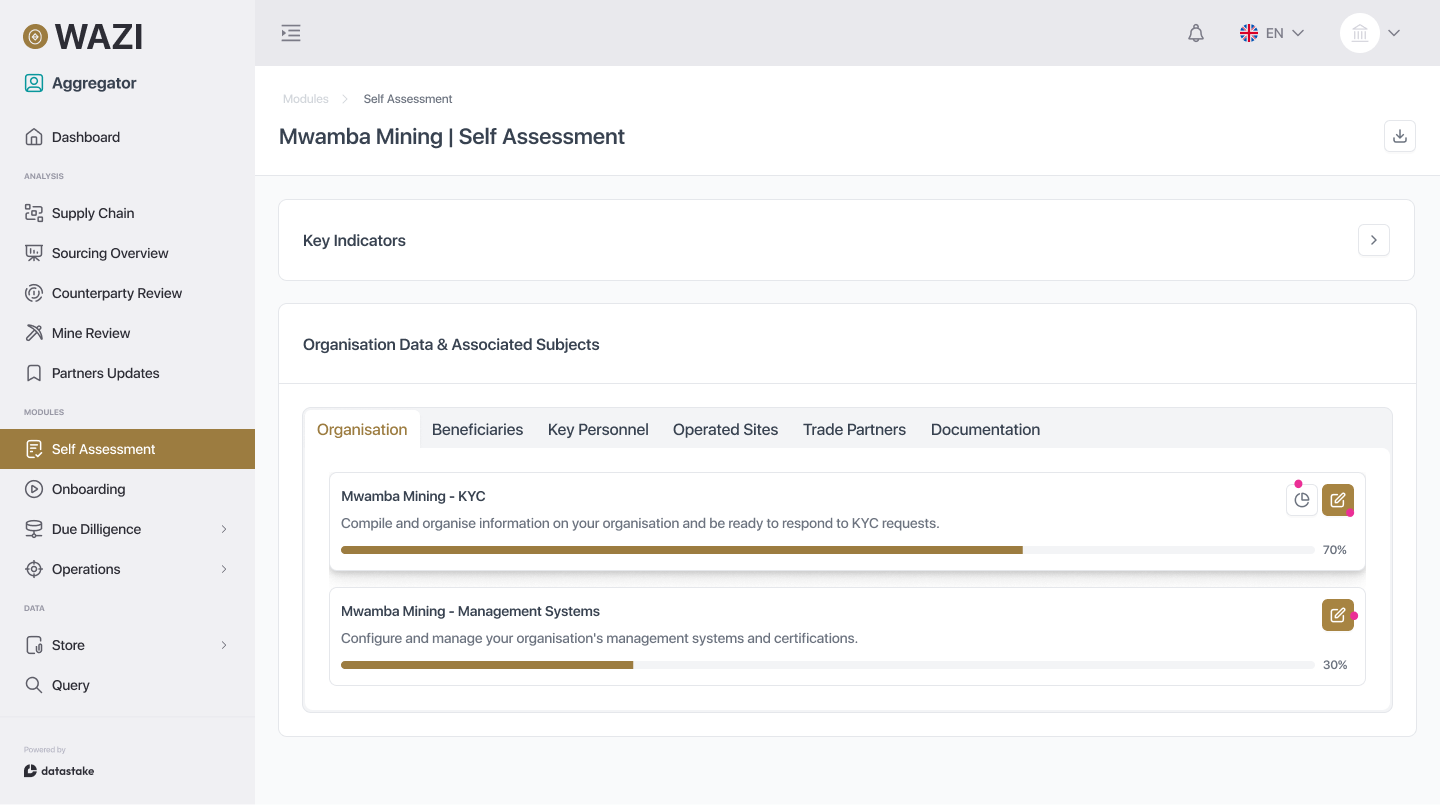
Self-assessment. The aggregator first documents its own organisational profile and governance posture. A structured KYC compilation covers the aggregator's identification, registration, organisational profile, governance, operations, policies, and trade relationships. Five management systems self-assessment forms evaluate the aggregator's own risk management systems against OECD Due Diligence Guidance Step 1 expectations: Supply Chain Policy, Internal Management Systems, Supply Chain Integrity, Supplier Engagement, and Grievance Mechanism. Associated subjects (beneficiaries, key personnel, operated sites, trade partners) are linked and assessable.
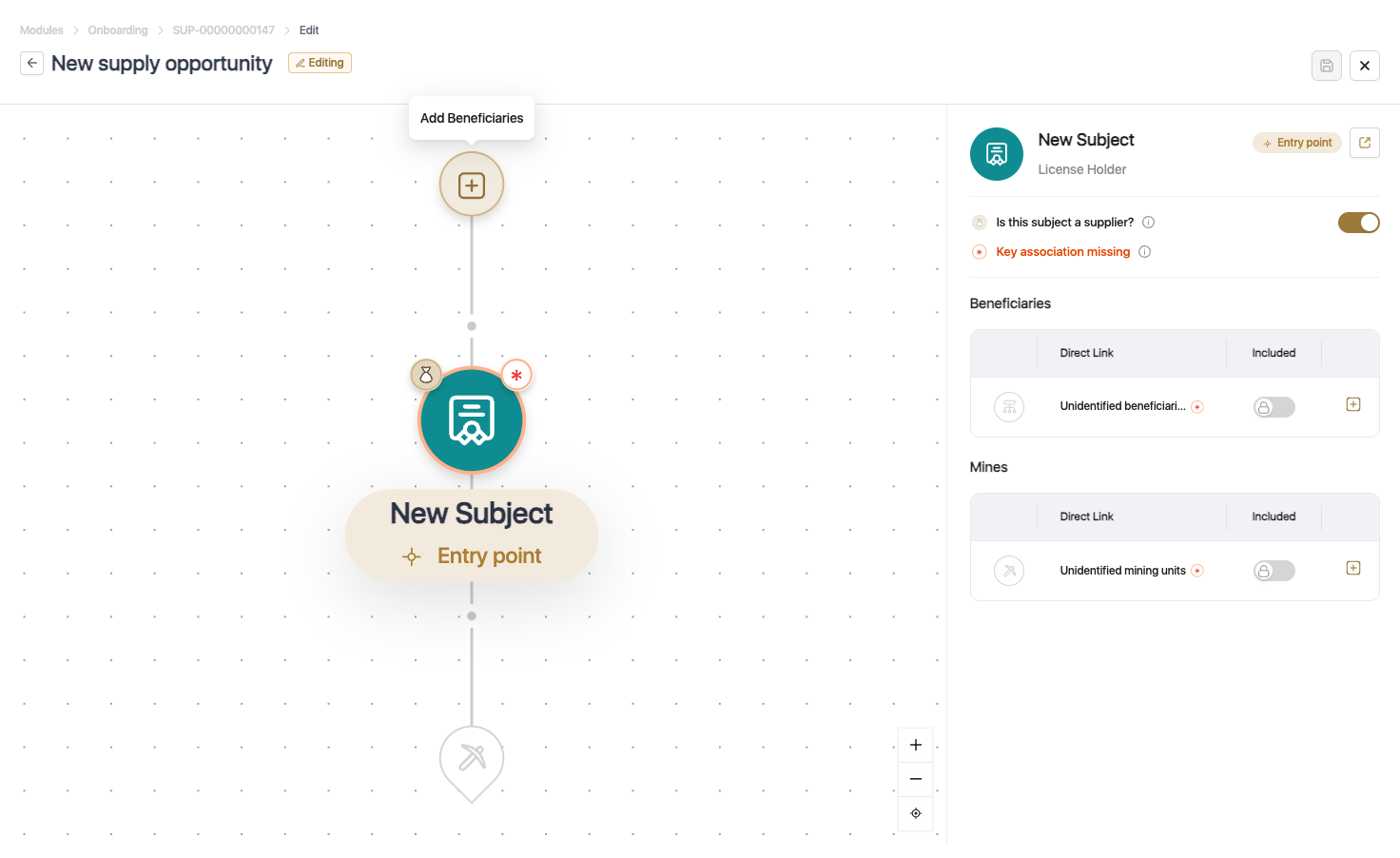
Onboarding supply opportunities. When the aggregator identifies a potential sourcing opportunity, they create a Supply Profile. This is the central analytical structure in WAZI: a structured representation of a single procurement opportunity, mapping the upstream value chain before engagement begins. Through successive steps, the aggregator identifies the entry point (a mining unit or a counterparty such as an operator, titleholder, or landowner), maps counterparties in their governance roles, identifies beneficiaries and expands ownership chains to ultimate beneficial owners (UBOs), and designates which counterparties will act as direct suppliers of material.
Due diligence. Once a supply profile is created, the aggregator conducts formal assessments on its subjects. Stakeholders are evaluated against KYC compliance criteria, documentation completeness, and (for operators) management systems readiness. Mining sites are assessed across six OECD Annex II domains: legality, human rights, conflict and security, environment, health and safety, and community. Events (incidents, activities, testimonials) are recorded as they occur and linked to relevant locations and stakeholders. Together, these assessment types and the continuous flow of events constitute monitoring: the ongoing recalculation and reinterpretation of supply chain risk based on all available information.
Operations. The aggregator records workforce information, production data, and shipments. Each shipment is a discrete sourcing transaction linked to a specific supply profile, its documented due diligence trail, and the full upstream value chain. Shipments serve as the anchor for reporting to downstream partners.
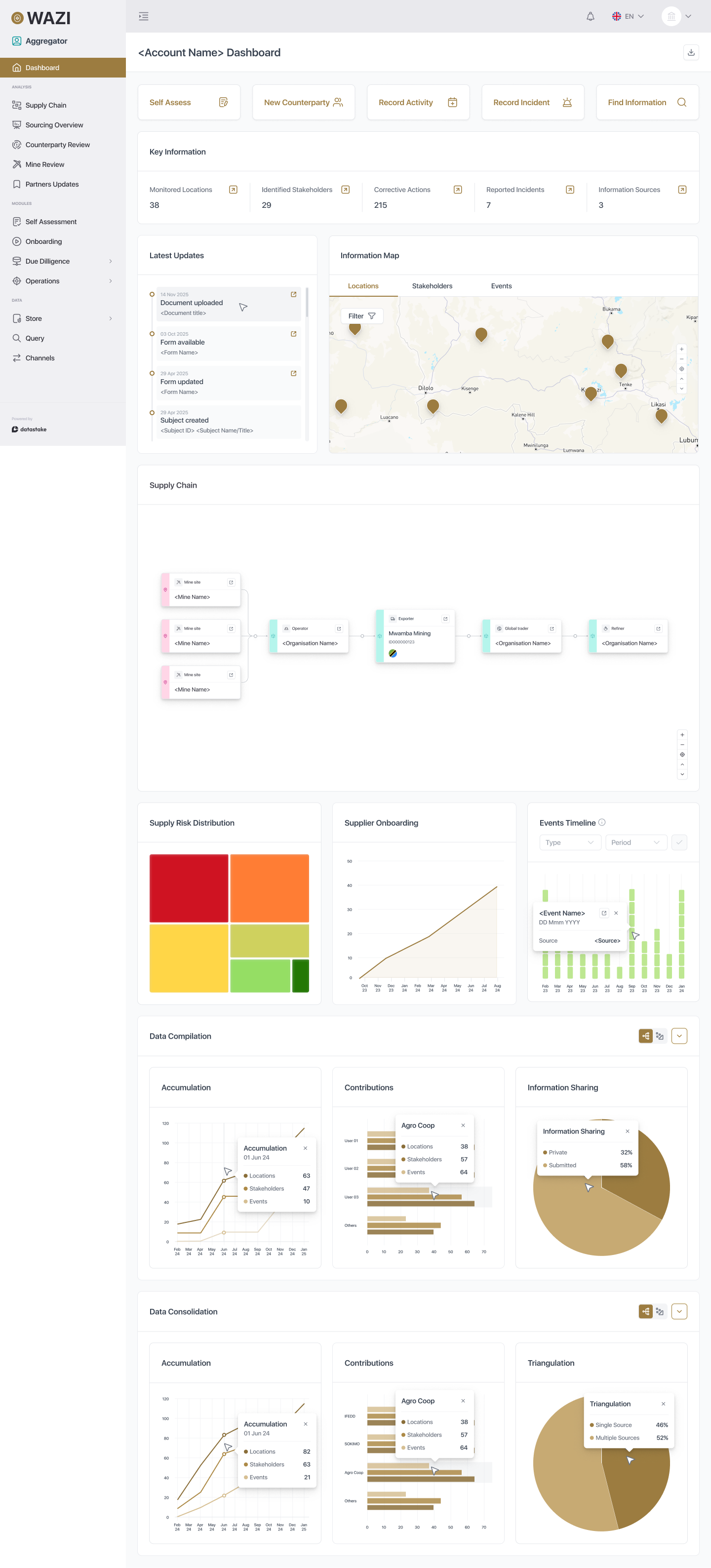
Reporting and analysis. Reporting is not a separate exercise. It is the direct output of the system, built progressively through Self-Assessment, Onboarding, Due Diligence, and Operations. Two approaches are supported: value chain-based reporting (presenting sourcing opportunities to buyers through consolidated Supply Profile views) and shipment-centric reporting (demonstrating continuous compliance per transaction). Dedicated analysis tools provide different lenses on the aggregator's portfolio: geographic supply chain visualisation, supply profile-level sourcing overview, counterparty-level deep dives, and mine site-level detail.
For the Operator
The Operator Interface is WAZI's upstream-facing surface. It serves the same function as in — structured self-representation by counterparties to an aggregator — with two WAZI-specific characteristics:
- Aggregator counterparty. The aggregator on the receiving side is Mwamba Mining at MVP. Configuration is identical at the form level; only the receiving aggregator differs.
- Counterparty breadth. The Operator Interface serves any WAZI counterparty: Mine Operator, Mine Title Holder, Land Owner. Future expansion adds material-supplying counterparties such as Traders and intermediate handlers under the same interface. The single Operator Account type encompasses all upstream supplier categories; differentiation happens at the Stakeholder Type level within the KYC form, not at the account or interface level.
The journey runs from invitation through registration, self-assessment, and ongoing engagement.
Registration. The operator receives an invitation (email or SMS) from Mwamba and registers on WAZI. Identification fields captured at registration pre-populate the operator's KYC profile.
Self-assessment. The operator completes the same structured KYC and Management Systems forms available to the aggregator, scoped to its own organisation and the locations it operates, holds title to, or owns. Supporting documents can be attached throughout. The same Algorithmic Stakeholder Evaluation Methodology that Mwamba applies to the operator's profile is the methodology the operator uses to build it; there is no asymmetry of criteria between the two sides.
Self-derived posture. The operator sees its own completion status across KYC and Management Systems forms, and its own algorithmic score computed on the data it has submitted. This is the operator's view of its own posture, derived from data it owns; it is not a window into the Aggregator's internal scoring or composite evaluations.
Ongoing engagement. Once a self-assessment is submitted, the operator responds to data requests from Mwamba and updates its profile as conditions change. Information compiled in WAZI is portable: an operator engaged with multiple aggregators publishes one verified profile and shares it via Channels, removing the need to repeat KYC and self-assessment per relationship.
Strategic positioning. The Operator Interface converts compliance from a buyer-imposed burden into a portable, reusable asset owned by the operator. Operators with up-to-date WAZI profiles become preferentially discoverable to aggregators evaluating new sourcing opportunities.
For the Partner
The Partner Interface is WAZI's downstream-facing surface. Partners are primarily buyers of gold from the Aggregator: refiners, traders, and certification bodies receiving consignments downstream of Mwamba.
Access at Aggregator discretion. Partners do not enter WAZI through self-registration into Mwamba's data. Access is granted by Mwamba on a per-Shipment basis through the Channel mechanism. The Partner Account holds no compilation capability of substance: Partners do not build profiles, run assessments, or onboard supply chains within WAZI. The interface is read-and-interpret.
Disclosure Package per Shipment. What the Partner receives for each Outbound Shipment is the Disclosure Package — a read-only snapshot bundle covering the Shipment record, the originating Supply Profile, the declared Suppliers and their KYC, the Locations associated with each Supplier, and the linked Events for each Subject in the package. The snapshot is frozen at Shipment confirmation; subsequent edits upstream do not alter delivered packages. Full contents and snapshot rules in §5.5.2.1.
Relationship to audit. The Disclosure Package is built to give receiving refiners a structured evidentiary base for their own due diligence and for the third-party audit obligations that sit on top of it (OECD Step 4, LBMA Independent Audit). It is not a substitute for audit. Where audit is required, the package shortens the auditor's path to source data; where continuous monitoring already reduces the marginal value of audit, the package documents that monitoring discipline.
Acceptance. Partners mark each Shipment Accepted or Not Accepted in their interface, with an optional note. Acceptance is recorded with timestamp and surfaced to the Aggregator. There is no in-app dispute mechanism; package corrections require the Aggregator to re-share an updated snapshot.
4. Data Ownership Model
Data custody is central to how WAZI operates. Every piece of information has an owner, and the system enforces clear rules about who can see, share, and modify data.
Aggregator compiles, aggregator owns. When the aggregator documents a supply chain (maps counterparties, conducts assessments, records events), that information belongs to the aggregator's account. No other aggregator can see or access it.
Operator self-reports, operator owns. When an operator completes a self-assessment, that data belongs to the operator's account. The operator decides which aggregators receive access to their profile. If an operator works with multiple aggregators, each relationship is managed independently without data leaking between them.
Sharing creates a controlled copy. When information is shared through a channel (aggregator to partner, or operator to aggregator), the recipient receives a scoped view of the data. The originator retains full ownership and can modify disclosure scope at any time. Partners cannot modify the data they receive, and aggregators cannot modify operator self-assessments.
Organisation isolation. Aggregator A cannot view, edit, or access any data belonging to Aggregator B. Cross-aggregator visibility is possible only through explicit channels and agreed-upon data-sharing arrangements.
Progressive accumulation. Information documented in WAZI is cumulative. Historical events, actor profiles, and assessments form a growing knowledge base that becomes more valuable over time. Upstream operators who maintain their profiles benefit across all supply chain relationships.
5. Domain Workflows
5.1 My Organisation (Self-Assessment)
v0.7 rename note. Module renamed from Self-Assessment to My Organisation in the sidebar reframe (see §5.5.5). The conceptual content — KYC + Management Systems + new Attestations and Compliance Checks forms in §5.1.8 — is unchanged. References to "Self-Assessment" throughout this Spec, in workflow names (W3, W4), and in OECD Step 1 mapping (§6) continue to refer to the same module.
5.1.1 Purpose and Logic
In WAZI, the Aggregator is not only a system user but also an assessed subject within the value chain. This reflects the compliance reality that downstream buyers are exposed not only to risks associated with upstream mining operations, but also to the governance, policies, and operational practices of the entity aggregating, processing, and selling the material.
The Self-Assessment module allows an Aggregator to compile structured information about its own organisation using the same evaluation logic applied to other supply chain actors. This ensures that due diligence within WAZI is applied consistently across all relevant entities in the value chain. As a result:
- Buyers can assess the entire supply chain, inclusive of the Aggregator.
- Due diligence methodologies remain consistent across upstream and midstream actors.
- Aggregator-level risks and mitigation measures are explicitly documented and visible.
The Self-Assessment module combines three core components: the Aggregator's organisational profile (KYC), its management systems (or due diligence systems) assessment, and the network of Associated Subjects linked to its operations.
An additional benefit is that the Self-Assessment module will then directly serve the Aggregator's suppliers, and the ASM sector at large, as a similar module can be built into the Operator interface (for the Aggregator's upstream partners, including presently informal actors).
5.1.2 KYC / Organisational Profile
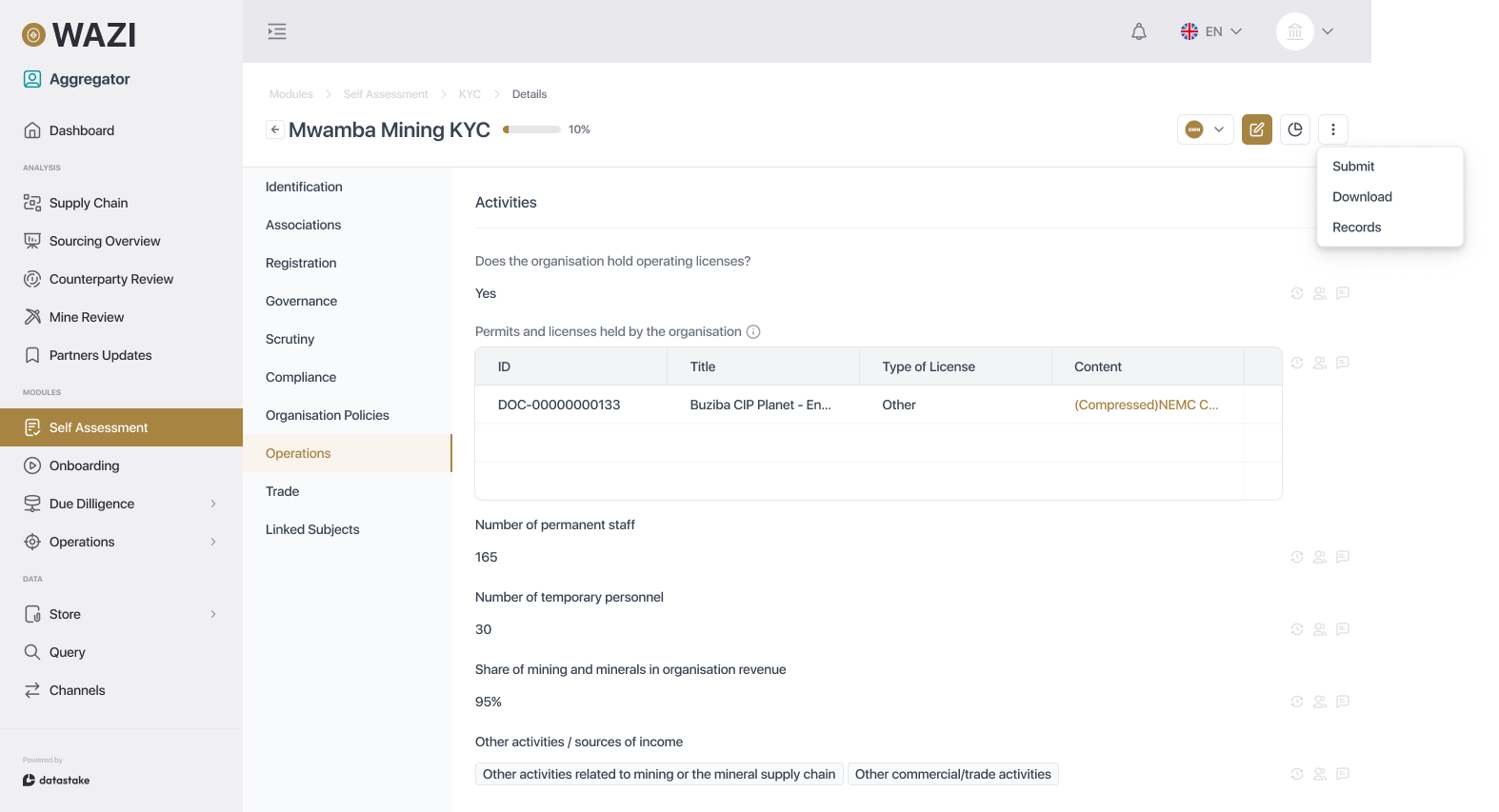
Objectives. The Aggregator first completes a comprehensive KYC form (organisational profile), equivalent in structure and intent to the stakeholder and operator profiles used for the evaluation of external counterparties within the system.
This profile captures key organisational information, typically including legal identity and registration details, ownership and control structure, management and key personnel, licensing and regulatory status, compliance declarations, and scope of operations and trade.
As this information is compiled, the Aggregator identifies and registers the relevant individuals and entities connected to its operations. These subjects (such as beneficial owners, managers, and trade partners) become independent entities within WAZI and are directly linked to the Aggregator's profile, referred to as Associated Subjects (or Linked Subjects).
By structuring this information in the same way as counterparty profiles, WAZI ensures that the Aggregator can be linked into value chains as a subject within the supply chain structure, assessed using comparable criteria applied to other actors, and included transparently in client-facing due diligence reporting.
In addition to supporting internal organisation of information, the KYC profile becomes a reusable data asset. Aggregators can maintain and update this information over time and reuse it across multiple reporting streams, including buyer due diligence requests, regulatory disclosures, banking relationships, and investor reporting.
Navigation.
- Select the Self-Assessment module to land on the Self-Assessment page.
- Open the KYC Form (
<Account Name> KYC). - Compile and save information across form sections (including Subject Linking).
- Visualise progress and indicators by navigating to the KYC Summary.
- Monitor overall risk readiness by navigating back to the Self-Assessment landing page.
- Consult and access Associated Subjects linked from KYC form compilation.
Tips and Guidance.
- The Trade section of the KYC (and that of any operator form) is intended for identification of direct trade relationships. For instance, a supplier's own suppliers or mining sites should be linked to that supplier subject (rather than to the Aggregator directly). This ensures appropriate mapping of the supply chain (e.g. Trade Relationships and Supply Chain Map widgets).
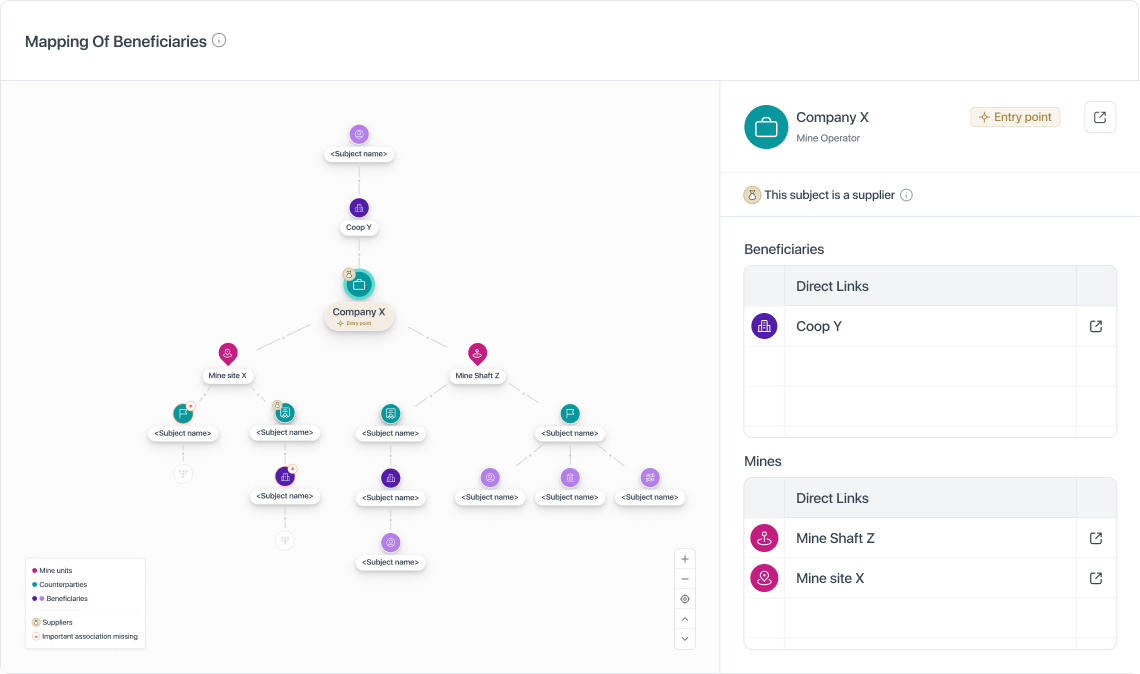
- Likewise, the Associations section is for the identification of direct shareholders and beneficiaries. Indirect beneficiaries should be linked to a chain of direct beneficiaries (rather than to the Aggregator directly). This ensures appropriate mapping of the ownership structure (e.g. Governance and Mapping of Beneficiaries widgets).
KYC Trade — dual feed. The KYC Trade section is editable directly: the Aggregator may add Suppliers and Mines of Direct Procurement at any time. It is also auto-populated when a Supply Profile is approved, per §5.2.6: Suppliers designated in the approved profile appear in KYC / Trade / Supply, and their Mines of Procurement appear as Mines of Direct Procurement. Auto-populated entries remain fully editable. A Supplier can be removed from KYC Trade even if it originated from an approved Supply Profile (e.g. if the Aggregator no longer wishes to surface the relationship in their own profile). A Mine of Direct Procurement can be deselected at the entry level. Removal at the KYC level does not affect the underlying Supply Profile record; it affects only how the relationship is surfaced in the Aggregator's KYC profile.
5.1.3 Management Systems Self-Assessment
Objectives. Beyond organisational identification, WAZI enables the Aggregator to evaluate the internal systems it has implemented to manage responsible sourcing risks.
Through a structured set of guided forms, the Aggregator performs a management systems self-assessment aligned with the OECD Due Diligence Guidance — particularly Step 1, which focuses on the establishment of strong company management systems with a focus on supply chain risk.
These self-assessment forms translate complex (or vague) international standards into clear reporting questions and indicators. Rather than requiring users to interpret global guidance independently — or hire expert consultants to do so — WAZI guides organisations through the reporting process and captures information in a consistent and analysable format.
Together, the KYC profile and management systems assessment generate indicators of the Aggregator's risk readiness within the WAZI framework.
Five forms (one per OECD Step 1 component, 1-A through 1-E):
- Supply Chain Policy (1-A)
- Internal Management System (1-B)
- Supply Chain Integrity (1-C)
- Supplier Engagement (1-D)
- Grievance Mechanism Features (1-E)
The Management Systems landing page lists all five with per-form completion progress and OECD step reference. The user opens each in turn (no required order) and fills it section by section. Each form is scored as Complete (1.0), Incomplete (0.5), or Unavailable (0.0) at form level. The composite Management Systems Readiness score (0–100%) rolls up across the five forms and feeds directly into the Aggregator's Tier 3 stakeholder assessment (and similarly applies to Operators / Supply Chain Actors evaluated through the Due Diligence module).
Areas covered include responsible sourcing policy and commitments, internal management systems and governance arrangements, risk identification and assessment procedures, supplier engagement and escalation processes, incident management and remediation procedures, and record-keeping and reporting practices.
The purpose of this module is not to certify compliance, but to document the existence and maturity of management systems, identify gaps or areas for improvement, and provide buyers with visibility into how due diligence is operationalised within the Aggregator's organisation. Management system assessments can be updated over time, supporting continuous improvement and transparency in responsible sourcing practices.
Navigation.
- Select the Self-Assessment module to land on the Self-Assessment page.
- Access the Management Systems landing page (lists the five forms with per-form progress).
- Open any of the five forms (no required order).
- Within a form, compile and save information across its internal sections; attach supporting documents per section.
- Monitor overall risk readiness by navigating back to the Self-Assessment landing page.
5.1.4 Associated Subjects
Objectives. WAZI allows the Aggregator to explicitly link itself to a network of Associated Subjects that together define its operational and risk context. This is primarily achieved through KYC form compilation, with cascading data accumulation on linked subjects.
Associated Subjects are not only counterparties or beneficiaries, but can span all four core Subject types (Stakeholders, Locations, Events, Documents) related to the Aggregator, including:
- Operated sites such as processing plants or mining locations
- Beneficiaries and ownership entities
- Trade partners and commercial relationships
- Management and key personnel
Each Associated Subject is treated as an information subject within the system and can be profiled using standardised forms, assessed using the same logic applied to trade counterparties, and included in monitoring and risk-scoring processes.
This associative model (Subject Linking) ensures that the Aggregator's assessment reflects the broader organisational and operational structure through which it conducts its activities, rather than being limited to a single entity record.
Navigation.
- Select the Self-Assessment module to land on the Self-Assessment page.
- Browse through the Associated Subjects tabs.
- Access individual subjects:
- Details: data compilation form.
- Summary: stakeholder or location analysis, score.
5.1.5 Tabling Rules
Of the five Associated Subjects tabs surfaced within the Self-Assessment module, three are read-only views of subjects already linked through the KYC form (Beneficiaries, Operated Sites, Trade Partners); the other two (Key Personnel, Documentation) are editable extensions of what the KYC form captures. Read-only tabs do not allow direct entry — subjects must be created or edited at the relevant KYC source section, or at the Trade Network / Sites tables in the Due Diligence module per §5.3.1 and §5.3.2 (see Pre-Onboarding subject mapping); changes propagate automatically. Editable tabs allow direct creation of additional records that do not need to be tied to a specific KYC section: Key Personnel can include team members beyond those linked under KYC / Governance / Management (for example, operational personnel not part of the formal management structure), and Documentation can include records not captured under Registration, Compliance, or Organisation Policies (for example, ad-hoc certifications, correspondence, or supporting evidence not associated with a specific KYC section).
| Tab | Edit mode | Source Sections |
|---|---|---|
| Beneficiaries | Read-only | KYC / Associations / Beneficiaries / Shareholders; KYC / Associations / Beneficiaries / Other beneficiaries; chain of shareholders and beneficiaries derived from those. |
| Key Personnel | Editable extension | KYC / Governance / Management; plus tab-side additions for personnel beyond formal management. |
| Operated Sites | Read-only | KYC / Operations / Operated Sites / Processing plants; KYC / Operations / Operated Sites / Mining sites; KYC / Trade / Supply / Mines of direct procurement. |
| Trade Partners | Read-only | KYC / Trade / Supply / Suppliers; KYC / Trade / Sales / Clients. |
| Documentation | Editable extension | Various documents linked across KYC sections (Registration, Compliance, Organisation Policies); plus tab-side additions for documents not tied to a KYC section. |
5.1.6 Integration into Value Chains and Reporting
The outputs generated through the Self-Assessment module are fully integrated into WAZI's value-chain analysis and reporting logic. As a result:
- The Aggregator becomes a scored component of the value chain.
- Shipment-level reporting can ultimately reflect risks and mitigation measures at Aggregator level.
- Buyers receive a consolidated view of upstream mines, intermediaries, and the Aggregator itself.
- From the buyer's perspective, this enables a consistent evaluation of where the material originates (mining sites), who handled it along the supply chain (trade partners), and how risks are managed at each stage of the chain — including at Aggregator level.
5.1.7 Role in Monitoring and Continuous Due Diligence
The Aggregator Self-Assessment is not a static exercise. WAZI supports continuous due diligence by allowing organisations to update and maintain their information over time. This includes periodic updates to KYC, organisational information and documentation; updates to Management System assessments as policies and procedures evolve; monitoring of changes in ownership, governance, or operational structure; and logs of corrective actions and system improvements.
These updates feed directly into updated value-chain assessments and scores, shipment-level summaries, and other forms of reporting to buyers and partners.
Compile once, reuse. The Self-Assessment is compiled once and parked. The Aggregator or Operator updates it as new information accumulates. The same compiled package is reused across applications to other parties (e.g. an Operator applying to be onboarded by an Aggregator), buyer due diligence requests, regulatory disclosures, banking relationships, and investor reporting. At MVP, the immediate reuse targets are simple. Architecturally, the same package can unlock multiple application flows for an Operator and equivalent reuse paths for an Aggregator post-MVP.
By translating complex international standards into structured reporting workflows, WAZI lowers the barrier for upstream actors — including informal ASM operators — to progressively engage with responsible sourcing frameworks.
Workflow.
| Step | Actor | Action |
|---|---|---|
| 1 | Account holder | Navigates to Self-Assessment module |
| 2 | Account holder | Completes KYC Profile covering organisational identification, registration, profile, governance, operations, policies, and trade relationships |
| 3 | Account holder | Completes five Management Systems Self-Assessment forms aligned with OECD Step 1 |
| 4 | Account holder | Identifies and links Associated Subjects (beneficiaries, key personnel, operated sites, trade partners) |
| 5 | Account holder | Attaches supporting documentation per section |
| 6 | Account holder | Submits completed self-assessment |
| 7 | System | Records submission timestamp and completeness; notifies linked aggregators |
Business rules.
- KYC and management systems forms are consistent across account types, enabling information consolidation from multiple sources.
- Management systems readiness scoring applies only to operators and supply chain actors (not individuals or non-operating entities).
- Self-assessment responses feed directly into downstream stakeholder assessment scoring.
- Associated Subjects identified through Self-Assessment (e.g. beneficiaries, operated sites, trade partners) are created as information subjects in the system and become assessable through the Due Diligence module.
MVP Defaults (Locked).
- KYC compilation follows a consistent structure across all account types.
- Management systems self-assessment aligns with OECD Due Diligence Guidance Step 1 (5 forms).
- The self-assessment forms are organised into sections with progressive disclosure, built upon Datastake's Consolidated Due Diligence Framework developed in partnership with the European Partnership for Responsible Minerals (EPRM) in 2020.
5.1.8 The Compliance Forms — Attestations and Compliance Checks
Two further forms sit alongside KYC and Management Systems within the Aggregator's (and Operator's) own profile under the My Organisation module: Attestations and Compliance Checks. Both are introduced in response to client feedback and reflect the separation between data compilation and confirmation.
Attestations is a binary self-confirmation surface. Four required statements (legal registration of the organisation; authorisation of the person completing the profile; agreement to comply with the Supplier Code of Conduct; accuracy and completeness of the profile to the best of the signer's knowledge) gate the organisation's readiness to share its profile with partners. Status is binary across the four items; there is no scoring contribution and no per-statement granularity beyond confirmed / not confirmed.
Compliance Checks is an actor-typed checklist that confirms the organisation has done what the underlying compliance frameworks (OECD Due Diligence Guidance, LBMA Responsible Gold Guidance, locally-applicable obligations) require. The Q-set is structured in two parts: common questions across all actor types (Legal & Regulatory Status, Ownership & Governance, Financial & Transaction Integrity, Human Rights & Labour, Security & Conflict, Responsible Sourcing & Traceability) and actor-specific questions per Stakeholder typology (Mining, Trading, Processing, Exporting). At v0.7 the checks are not scored; their relationship to the scoring framework is a separate decision deferred until the form is in use and real responses can be observed.
Source-Pointer principle. Each check in the Compliance Checks form resolves to one of three states: (a) the underlying record already lives in WAZI in a specific form section (e.g. a licence held in KYC > Registration); the row points to that source via an info button + open-in-form button so the user navigates to the source rather than re-entering the data; (b) the check is a free-text confirmation made directly in the form (typical for self-declarations that have no canonical record source — armed-group exposure, freedom to leave, etc.); (c) the underlying surface to confirm against is itself a gap to be added (engineering work item, captured in the v0.7 engineering handover). The pattern means the user is not asked to re-enter data already held elsewhere; the Compliance Checks form is a confirmation layer over normal WAZI use, not a duplicate data-entry burden.
The Source-Pointer principle is complementary to the Pre-Onboarding subject mapping principle in §5.3 (direct creation in DD aggregation tables). The former resolves "this confirmation already lives in WAZI; here is where"; the latter resolves "this subject was encountered before the structured workflow that would normally surface it". Both principles share a single root: the canonical record lives in one place and is referenced — not duplicated — wherever else it surfaces.
Jurisdictional placeholders. Several Compliance Checks reference jurisdictional authorities and statutes (e.g. "the relevant tax authority", "the relevant mining authority", "applicable environmental law"). These are implemented as per-locale i18n strings so the form ships locale-agnostic, with per-deployment strings loaded from locale configuration. This is the first concrete instance in WAZI of the jurisdictional configuration concept noted at the framework level in .
Why decoupled from scoring at v1. The 16-criterion KYC scoring framework remains the scoring backbone for the Stakeholder layer. Adding Attestations and Compliance Checks as scoring inputs would require re-derivation of the scoring engine and would compress the decision on each new form's weighting before real-world responses can inform it. Decoupling lets both forms ship for client use immediately while the scoring relationship is decided on observed evidence. See 2026-05-18 — Attestations and Additional Information as WAZI-unique forms, decoupled from scoring.
5.2 Onboarding (Supply Opportunities)
5.2.1 The Challenge of Structuring ASM Supply Opportunities
ASM supply opportunities rarely emerge in a consistent or transparent form. Sourcing relationships develop informally through personal networks, local intermediaries, or opportunistic introductions rather than through clearly documented commercial arrangements. When an aggregator first becomes aware of a potential sourcing opportunity, the underlying supply chain is often only partially understood.
The economic and operational structure surrounding an ASM mine can be complex and fragmented. A single mining location may involve multiple actors performing distinct roles within the production system, including:
- Mine operators responsible for extraction activities (e.g. cooperative, mining company)
- Titleholders or permit holders (PML holders)
- Landowners
- Service providers or equipment contractors
- Traders or intermediaries involved in the commercialisation of gold
Not all these actors are direct suppliers of gold. Some participate economically through royalties or service arrangements without ever physically handling production. Ownership structures associated with these actors may be unclear, layered, or only partially documented.
Before due diligence assessments can be conducted, the supply chain itself must be understood. WAZI's onboarding process addresses this challenge by providing a systematic method for mapping supply opportunities and organising the information required for subsequent due diligence. In its current MVP implementation, this reconstruction is performed primarily by the aggregator. The architecture is designed to progressively support upstream actors signalling their interest directly via the Operator Interface.
5.2.2 Purpose of the Onboarding Process
Onboarding is the process through which a potential supply opportunity is identified, documented, and preliminarily structured before regular sourcing begins. The objective is not to certify compliance or perform a full due diligence assessment, but to:
- Understand the operational context in which production takes place
- Identify the mining units associated with the opportunity
- Identify the counterparties involved in the supply chain
- Map the beneficiary and ownership structures linked to those actors
- Determine which actors are expected to supply gold to the aggregator
The output of this process is a Supply Profile, the central analytical structure in WAZI. Everything downstream (due diligence, monitoring, operations, reporting) is organised around it.
Onboarding and Application — two ends of one transaction. Onboarding is the Aggregator-side workflow through which counterparties are mapped, assessed, and integrated. The Operator-side counterpart is the Application flow: an Operator applies to be onboarded by a specific Aggregator by submitting their compiled Self-Assessment package. The Aggregator then processes that application via its Onboarding tools. The two flows meet in the middle: one Operator's Application becomes one Aggregator's Onboarding entry.
The Application workflow (post-MVP). At MVP, Onboarding is initiated and driven by the Aggregator. Post-MVP, registered Operators can self-initiate the application flow: select a target Aggregator (or follow an invitation link), confirm completion of their KYC (W3) and Management Systems (W4) self-assessment, and submit the package. There is no separate Stage 1 Application form. The application is the Operator's self-assessment data itself. The Aggregator receives a notification, reviews the submitted package via the Stakeholder Assessment surface (W7) with all Operator-submitted fields pre-populated, and decides on outcome (accept, decline, or request additional information). An Operator may apply to multiple Aggregators in parallel; an accepted application makes the Operator a recognised stakeholder for that Aggregator and unlocks inclusion in subsequent Supply Profiles (W5).
MVP scope note on counterparty terminology. "Operator" is used in this specification as a stand-in for any counterparty that may apply for onboarding. A solution for non-operating counterparties (titleholders, landowners, procurers without Operator status) is deferred to a post-MVP iteration.
5.2.3 Core Concepts of the Supply Profile
Objectives. The Supply Profile provides a holistic representation of a procurement opportunity by identifying the key components of the gold value chain associated with that opportunity. Rather than treating sourcing relationships as bilateral trade arrangements, the Supply Profile captures the broader operational and economic configuration surrounding mineral production and commercialisation. It consolidates information on mining units, counterparties, beneficiaries and ownership structures, and entities physically supplying material. Once established, this model serves as the foundational structure for Due Diligence within WAZI.
Entry Point. A Supply Profile begins with the identification of an Entry Point, representing how the sourcing opportunity first becomes known to the aggregator. Entry points may include:
- A mining site
- A mine operator or cooperative
- A landowner
- A mine titleholder
The entry point does not necessarily represent the supplier of the material. It simply reflects how the aggregator becomes aware of the opportunity. From this starting point, the onboarding process expands to identify the full network of actors and locations.
Mine Sites / Mining Units. Mining units are Sites (Location-type Information Subjects) representing the physical locations where production occurs. They anchor the operational dimension of the Supply Profile and subsequent Due Diligence activities. Mining units may include:
- Mining Site (equivalent to a PML)
- Mining Area (equivalent to a group of PMLs)
- Mining Shaft or individual pit (part of a PML)
These units provide the geographic and operational reference points through which the value chain is structured.
Counterparties. Counterparties are actors with economic or operational roles within the mining system associated with the Supply Profile. Counterparty roles fall into two categories:
Governance roles (the Counterparty holds legal or operational authority over a Mine):
- Mine operators responsible for extraction activities
- Mine titleholders
- Landowners
Procurement role (the Counterparty sources gold directly from a Mine without governance authority):
- Procurers — typically traders, cooperatives, or buying agents that aggregate material from mines they do not operate
Counterparties are mapped in relation to mining units via either a Governance Link or a Procurement Link (see §5.2.4). Not all counterparties physically transfer gold, but they may influence production, revenue distribution, governance conditions at the mining site, or the material flow itself.
Beneficiaries. Each counterparty identified within the Supply Profile must be linked to its beneficial ownership structure. Beneficiaries are drawn from two data points in the counterparty's Stakeholder record: Shareholders and Other direct beneficiaries.
Where a Beneficiary is itself a Business / Corporate Entity, the onboarding process expands the ownership chain by reading that entity's own Shareholders and Other direct beneficiaries. Recursion continues until each branch terminates: an Individual entry establishes a UBO; a non-corporate non-individual entry (e.g. civil society organisation, government body) terminates without UBO determination.
Linked Beneficiaries cannot be removed from the Supply Profile by the Aggregator. Mandatory placeholder slots (e.g. "Unidentified beneficiaries") may be filled in but not deleted.
Suppliers. Within a Supply Profile, WAZI distinguishes between counterparties and suppliers. Many actors may participate in the production ecosystem, but only some physically introduce gold into the aggregator's procurement flow. Examples of counterparties that may not be suppliers include landowners receiving royalties, titleholders receiving revenue shares, and contractors providing operational services. WAZI uses a Supplier Toggle to allow the aggregator to designate which counterparties will act as direct suppliers of material.
5.2.4 Onboarding Workflow
The Onboarding workflow provides a process through which aggregators progressively construct the Supply Profile associated with a potential sourcing opportunity. Through successive steps, the aggregator identifies the key components of the supply chain and expands the Supply Profile until the sourcing context (or value chain associated with the entry point) is sufficiently understood. The fundamental goal is to identify all relevant Mining Units, their Counterparties, the network of Beneficiaries linked to Counterparties, and which of those are gold custodians and Suppliers.
High-level workflow.
| Step | Actor | Action |
|---|---|---|
| 1 | Aggregator | Creates new Supply Profile; identifies entry point |
| 2 | Aggregator | If entry point is a mine site: identifies counterparties in three governance roles (operator, titleholder, landowner) for that location |
| 3 | Aggregator | If entry point is a counterparty: identifies all mining units associated with that counterparty, then maps governance roles per mining unit |
| 4 | Aggregator | For each counterparty: initiates KYC form and beneficiary mapping |
| 5 | Aggregator | Expands beneficiary chain recursively. Recursion continues for Business / Corporate Entity beneficiaries; terminates at Individuals (UBO found) and at non-corporate non-individual entries (no UBO determination required) |
| 6 | Aggregator | Designates the Supplier: the specific counterparty who physically introduces gold into the aggregator's chain of custody |
| 7 | System | Validates mapping: at least one mining unit and one designated supplier required |
| 8 | Aggregator | Reviews and submits for approval |
| 9 | System | Transitions supply profile to Approved status; creates formal subject records for all identified actors and locations |
Supply Profile Mapping Rules. The Onboarding workflow follows a set of structural rules that govern how Supply Profiles are initiated, expanded, and validated. These rules group into four categories: (1) Entry Point Identification, (2) Counterparty Typology, (3) Automatic Mapping, (4) Expansion Rules.
(1) Entry Point Identification. Each Supply Profile begins with the identification of an Entry Point, representing how the sourcing opportunity first becomes known to the aggregator.
- The Entry Point may correspond to either a Mining Unit or a Counterparty (Operator, Land owner, Mine titleholder).
- If the Entry Point corresponds to a Mine, the subject created or used in the system is a Location (Mine Site).
- If the Entry Point corresponds to a Counterparty, the subject created or used is a Stakeholder.
- If the Entry Point is a new subject, the Supply Profile initially contains only that subject.
- If the Entry Point already exists in the system (e.g. previously created through Due Diligence data compilation), the Supply Profile automatically retrieves and displays the existing linked subjects associated with that Entry Point.
(2) Counterparty Typology Rules. Counterparty classification follows predefined rules based on the role the Counterparty plays. These rules apply wherever the Counterparty appears in the profile, not only at Entry Point creation.
- Operators must be classified as Business Entity with Activity Sector = Mining & Metals and Position in Supply Chain = Mining Operator. Individual operators (e.g. an ASM site administrator) are classified as Business Entity with Legal Form = Sole Proprietorship. This classification is enforced rather than merely defaulted: the Operator-to-Mine link is exposed only in the Operations section of a Stakeholder form, which itself only appears on Stakeholders classified as Supply Chain Actors. A non-SCA cannot structurally hold an Operator link.
- Landowners and Titleholders may be of any Stakeholder type, including Individual. The role does not constrain classification.
- Procurers (Local Traders) are Supply Chain Actors by default: Business Entity with Activity Sector = Mining & Metals, Position in Supply Chain set to the trader sub-position per Config. Same SCA classification as Operators (different position).
(3) Automatic Mapping of Linked Subjects. Once an Entry Point is selected, WAZI automatically expands the Supply Profile by retrieving or requiring the identification of relevant linked subjects. Expansion is bounded: it travels one hop from the Entry Point and does not recurse into governance-completing counterparties' other mines (see Rule 4 for the boundary logic and the Supplier Toggle trigger).
- If the Entry Point is a Mine, the Supply Profile identifies the three governance counterparties of that mine: the Mine Operator, the Landowner, and the Mine titleholder. Where a role is genuinely not known, it may be flagged as Unidentified (see Rule 4 "Mandatory Governance Mapping"). Procurement links to the Mine from external Counterparties are not automatically enumerated — Procurers appear around a Mine only if they are themselves in the profile.
- If the Entry Point is a Counterparty with a governance role, the Mines linked via that role are surfaced as mandatory — operated mines for an Operator entry point, titled mines for a Titleholder entry point, land-owned mines for a Landowner entry point. Other linked Mines of the same Counterparty (mines held under a different governance role, or mines procured from) are surfaced as optional additions.
- If the Entry Point is a Counterparty with a procurement role (Procurer), the Mines procured from are surfaced as mandatory.
- In all Counterparty-entry cases, for each surfaced Mine the three governance counterparties of that Mine are surfaced to complete the governance mapping (each may be Unidentified).
- In addition, the system surfaces the Counterparty's Beneficiaries (Shareholders and Other direct beneficiaries from the Stakeholder record) for identification.
(4) Supply Profile Expansion Rules. As the Supply Profile grows, expansion rules govern how the structure develops while keeping the scope intentional.
Bounded expansion (two triggers, no others):
- Entry Point Expansion (structural). Rule (3) applies one hop from the Entry Point.
- Supplier Toggle Expansion (provenance-driven). When a Counterparty in the profile is toggled as Supplier, any Mines linked to that Counterparty (governance or procurement) not already in the profile are added, with full three-role governance completion on each newly added Mine.
- No other triggers. Mines and Counterparties enter a Supply Profile only via Entry Point Expansion or Supplier Toggle Expansion. There is no manual addition pathway. Counterparties surfaced only to complete a Mine's three-role governance mapping do not trigger further expansion: their other linked mines remain outside the profile and do not render. To bring those mines in, the Counterparty must be toggled as Supplier.
Mining unit structure:
- Every Mine in the Supply Profile must have its three governance Counterparties identified (Operator, Titleholder, Landowner) or explicitly flagged as Unidentified (e.g. "Unidentified mine operator"). Unidentified values count as information gaps and affect scoring but do not block approval.
- Counterparties tied to an in-profile Mine via governance role cannot be removed while that Mine remains in the profile.
- Counterparties linked only via Procurement may be removed; the Mine they procure from can remain if governance-linked to another retained Counterparty.
- Mining units may be removed from the Supply Profile if not relevant to the sourcing opportunity, provided no retained Counterparty structurally requires them.
Beneficiary mapping:
- Each Counterparty included in the Supply Profile must be linked to its Beneficiaries via two data points in the Stakeholder record: Shareholders and Other direct beneficiaries.
- Where a Beneficiary is itself a Business / Corporate Entity, the system expands the ownership structure by reading that entity's own Shareholders and Other direct beneficiaries.
- Recursion continues until each branch terminates: an Individual entry establishes a UBO; a non-corporate non-individual entry (e.g. civil society organisation, government body) terminates without UBO determination.
- Linked Beneficiaries cannot be removed from the Supply Profile by the Aggregator. Mandatory placeholder slots (e.g. "Unidentified beneficiaries") may be filled in but not deleted. Removal of a Counterparty (per the Mining Unit Structure rules above) cascades to remove its Beneficiary chain from the profile rendering; underlying subject-record linkages persist for use elsewhere (Due Diligence, future profiles).
Multi-hop procurement (individual subject level):
- Trade relationships beyond the immediate Counterparty-to-Mine link (e.g. a Counterparty sourcing from a trader who sources from a mine) are captured at individual subject level in the Counterparty's KYC / stakeholder record under Trade Relationships. They are visible in Due Diligence.
- Rendering of multi-hop procurement chains in the Supply Profile graph is deferred to a post-MVP release.
Supplier Identification. Within the Supply Profile, not all counterparties are suppliers. The aggregator must designate which counterparties will act as direct Suppliers by activating the Supplier Toggle. This distinction allows the system to differentiate between actors who participate in the mining economy and those who physically introduce gold into the aggregator's procurement flow (i.e. Trade Relationships). The Supplier Toggle also acts as an auto-expansion trigger per Rule (4) — surfacing the Supplier's governance- and procurement-linked Mines so the aggregator can assess the full set of potential sources. The aggregator may narrow the declared mine scope per Supplier; de-selected mines are retained as linkages in the subject record and flagged in Due Diligence as "linked but not declared".
Supplier Eligibility. Only Counterparties whose underlying Stakeholder classification is Business Entity with Activity Sector = Mining & Metals can be designated as Supplier. This is always true for Operators (per the Typology Rules above, including individual operators classified as Business Entity with Legal Form = Sole Proprietorship). For Titleholders, Landowners, and Procurers, the Supplier Toggle is gated on classification: if the Counterparty is an Individual or a Business Entity in a non-mining sector, the toggle is disabled.
Supply Profile Completion Conditions. A Supply Profile may be reviewed and approved once the sourcing structure is sufficiently understood. Minimum completion requirements are:
- At least one Mining Unit included in the Supply Profile
- At least one Supplier identified within the Supply Profile
The identification of complete beneficiary chains is not mandatory for Supply Profile approval. However, incomplete beneficiary information may influence the risk assessment associated with the value chain. Specifically:
- Not all Beneficiaries are required to be identified.
- Identification of all Ultimate Beneficial Owners (UBOs) is not required for Supply Profile completion.
These elements may instead be addressed during subsequent Due Diligence activities.
Navigation.
- Select Onboarding Module → Onboarding landing page / table presenting all created Supply Opportunities.
- Create new Supply Profile and follow creation steps in the drawer.
- Visualise gaps and follow path to individual Subjects to fill them through linking additional information (Due Diligence section).
- Visualise progress and indicators by navigating to the Supply Profile Summary.
Data Structure and Subject Mapping (Tabling Rules in Due Diligence Module). Subjects created during Onboarding propagate into the Due Diligence module's tables according to the following rules:
- Counterparties and Beneficiaries created as part of Supply Profile creation are added to (and may originally be created in) the Trade Network table in the Due Diligence module:
- Counterparties tab
- Beneficiaries tab
- Counterparties identified as Suppliers are further listed in the Suppliers tab. Suppliers from a Supply Profile not yet Approved carry Status = Opportunity; once the Supply Profile is Approved (or where the Supplier originates from KYC Trade), Status = Confirmed.
- Counterparties are further identified by their type (Operator, Titleholder, Landowner).
- Mining Units identified as part of Supply Profile creation are added to (and may originally be created in) the Sites table in the Due Diligence module.
5.2.5 Supply Profile Analysis
Once a Supply Profile has been constructed, WAZI provides tools to analyse the structure and completeness of the mapped sourcing opportunity. The objective is to allow the aggregator to evaluate whether sufficient information has been gathered to understand the supply chain and proceed with due diligence activities.
The Supply Profile consolidates all subjects relevant to the procurement opportunity:
- The Entry Point (Counterparty or Mine)
- The Mining Units included in the sourcing context
- The Counterparties associated with those mining units
- The Beneficiary networks linked to those Counterparties
- The Suppliers expected to deliver gold to the aggregator
Each becomes an Information Subject within the WAZI ecosystem and can subsequently be assessed individually (see Due Diligence module).
Typical analytical indicators include:
- Availability and completeness of information across subjects
- Identification of relevant mines and counterparties within scope
- Identification of direct suppliers
- Visibility of beneficiary and ownership structures
- Individual assessment outcomes of mines, counterparties, and suppliers (assessments are performed automatically based on available information)
Navigation.
- Select Onboarding Module → Supply Opportunities table.
- Open the relevant Supply Profile.
- Navigate to the Supply Profile Summary to visualise mapped subjects, information completeness indicators, and analytical widgets related to the value chain.
- From the Supply Profile Summary, navigate to individual Subjects to complete missing information or expand Due Diligence assessments.
5.2.6 Supply Profile Approval
Once the Onboarding analysis is complete and the structure of the sourcing opportunity is sufficiently understood, the aggregator may approve the Supply Profile.
Approval confirms that the aggregator has obtained a satisfactory understanding of the supply chain configuration and considers the sourcing opportunity suitable for further engagement (e.g. based on its aggregate score, or other configurable factors). Approval does not constitute a certification of compliance. Instead, it confirms that the supply chain structure has been sufficiently mapped to allow continuous due diligence activities and sourcing operations to proceed.
When a Supply Profile is approved:
- All Counterparties designated as Suppliers in the profile (a profile may contain several) become formal suppliers within the aggregator's supplier registry.
- These Suppliers appear in the Trade / Supply section of the aggregator's KYC profile.
- The Mining Units linked to each such Supplier within the approved Supply Profile become that Supplier's Mines of Procurement in the aggregator's KYC profile.
- They become part of the aggregator's monitored supplier base within the system.
- Future Shipments can reference these Suppliers; their confirmed Mines of Procurement are inherited automatically into the Inbound shipment form.
Other mapped Counterparties remain visible in the Supply Profile and Due Diligence subject tables but are not classified as direct suppliers unless explicitly designated as such.
Where the same Supplier participates in multiple approved Supply Profiles, their Mines of Procurement in KYC aggregate across all such profiles.
Approval marks the transition from structuring a supply opportunity to managing a sourcing relationship within the WAZI ecosystem.
Navigation.
- Select Onboarding Module and open the relevant Supply Profile.
- Navigate to the Supply Profile Summary.
- Review completeness, scoring and other Supply Profile indicators, as well as mapped subjects.
- Select Approve Supply Profile once the sourcing structure is considered sufficiently documented.
5.2.7 Role of Onboarding in the Due Diligence Process
Onboarding does not perform the full due diligence assessment itself. Instead, it establishes the structural scope within which due diligence activities will be conducted. By mapping the actors, locations, and ownership structures associated with a sourcing opportunity, the onboarding process defines the set of subjects that must be evaluated as part of responsible sourcing.
Once a Supply Profile has been created:
- Counterparties and suppliers can be assessed through guided stakeholder evaluations.
- Mine sites can be assessed through site-level due diligence reviews.
Once a Supply Profile has been approved:
- Monitoring activities can begin, including the documentation of incidents, activities, and other developments affecting the value chain.
- Shipments can be linked to their value chain, enabling reporting grounded in documented due diligence.
Onboarding functions as the structural foundation of the WAZI due diligence framework. It transforms an initially unstructured sourcing opportunity into a documented value chain that can be assessed, monitored, and reported on over time.
MVP Defaults (Locked).
- Entry points are classified as either a mining location or a counterparty (operator, titleholder, landowner).
- Three governance roles per mining unit: operator, titleholder, landowner.
- Supplier designation is formalised upon supply profile approval.
- Beneficiary chain expansion follows ownership structures through corporate layers to natural persons (UBOs).
- Mining units associated with counterparties may be removed from the Supply Profile if not relevant to the sourcing opportunity, but counterparties associated with mining units present in the profile cannot be removed (structurally necessary for value chain representation).
By structuring the way supply opportunities are documented and evaluated, WAZI makes it possible to progressively extend codified due diligence practices across large numbers of upstream ASM actors, many of whom currently lack practical mechanisms to present verifiable information about their operations.
5.3 Due Diligence
Due diligence in WAZI is structured across three interconnected assessment types and a continuous monitoring layer. All assessments use algorithmic scoring derived entirely from structured data. No subjective expert judgement is applied to calculate scores. This approach does not eliminate the need for field engagement, verification, or expert review where appropriate. Rather, it provides a more consistent and scalable framework through which supply chain actors can be reviewed across large numbers of counterparties and locations.
Onboarding establishes the structural scope within which due diligence activities are conducted. By mapping the actors, locations, and ownership structures associated with a sourcing opportunity, the onboarding process defines the set of subjects that must be evaluated. Once a Supply Profile is created, counterparties and suppliers can be assessed through guided stakeholder evaluations, and mine sites can be assessed through site-level due diligence reviews. Once approved, monitoring activities begin and shipments can be linked to their value chain.
The Due Diligence module compiles all subjects identified through Self-Assessment and Onboarding into two subject tables, Trade Network (Stakeholders: Counterparties, Suppliers, Beneficiaries) and Sites (Mining Units, Processing Plants, Other Locations), alongside three event-category sections (Activities, Incidents, Testimonials). The two subject tables also support direct creation for the subject types where it adds value — Counterparties in Trade Network, and Sites of any category. Subjects in these tables are not duplicated copies of records held elsewhere: they are the same information subjects, viewed through the due diligence lens, populated through four paths (upstream flow-in, direct creation, cascading linking, and Onboarding via Supply Profile expansion).
Pre-Onboarding subject mapping. Direct creation of Counterparties in Trade Network and Sites in the Sites table reflects an operational reality: an Aggregator may need to record a subject at the moment it is encountered — a delivery turning up unannounced, a site identified through field work, a counterparty proposed informally — before the structured Onboarding workflow begins. Recording the subject at the point of encounter, rather than waiting for a Supply Profile to be initiated, prevents data loss and avoids ad-hoc workarounds. When Onboarding subsequently runs and the same subject is referenced (as an Entry Point, a governance Counterparty for a mine, or a Supplier toggled from a profile expansion), the existing record is retrieved rather than re-created. Direct creation is therefore a feed into Onboarding, not an alternative to it. The four creation paths converge on a single Information Subject store; the same record is viewed differently across surfaces but never duplicated. The principle is logged in (2026-05-05 entry).
5.3.1 Stakeholder Assessment
What it is. An evaluation of counterparties, suppliers, and beneficiaries against governance, compliance, and financial integrity criteria. Stakeholder assessments rely on algorithmic scoring, meaning evaluation outcomes are derived directly from the information available in the system rather than from a separate expert scoring workflow. The current MVP logic focuses on information availability and completeness, presence or absence of key governance and compliance indicators, objective identification of risks, controversies, or missing safeguards, and availability of supporting documentation.
Navigation.
- Select the Due Diligence module and open the Trade Network table.
- Access an existing subject record. On the Counterparties or All tab, the user may also create a new Counterparty via the table's top-right "+ Add Counterparty" button.
- Open the relevant Counterparty, Supplier or Beneficiary form and compile information across the relevant sections.
- Save the information and navigate to the corresponding Summary / Review page to visualise indicators, score outputs, and associated documentation.
- Where counterparties are linked to a Supply Profile, they can also be accessed through the relevant Supply Profile Summary.
Trade Network table — subject population rules. Three paths populate the Trade Network table:
- Upstream flow-in. Counterparties via Supply Profile entry-point or counterparty linkage (Onboarding). Suppliers via the Aggregator's KYC Trade section or Supplier Toggle in Supply Profiles. Beneficiaries via KYC Associations.
- Direct creation in DD via the table's top-right "+ Add Counterparty" button — the canonical Pre-Onboarding subject mapping entry point for Stakeholders. Available on the Counterparties and All tabs. Counterparty is the only role offered for direct creation; Beneficiary and Supplier "Add" actions are intentionally not offered, because those roles always emerge from context (KYC linking, Supply Profile expansion, or cascading from another stakeholder). Direct Counterparty creation supports recording subjects at the moment they are encountered, ahead of any Supply Profile work. When Onboarding subsequently runs, the existing record is picked up.
- Cascading links inside an existing Stakeholder record (e.g. a Counterparty's own beneficiaries, suppliers, or operated sites become DD subjects when linked).
Direct Counterparty creation — minimum data. Country (pre-selected to the Aggregator account's country, editable), Category, Subcategory (e.g. Legal Form if Category = Business Entity), Name, and Counterparty Type (Mine Operator / Mine Titleholder / Landowner). Selecting Mine Operator auto-sets Economic Sector = Mining & Metals and Position in Supply Chain = Mining Operator. Titleholder and Landowner accept any Category. Mine linkage in Associations or Operations is recommended at creation but not mandatory.
Trade Network table — tabling rules. The table is organised into four tabs (All, Counterparties, Beneficiaries, Suppliers).
| Tab | Population Rule |
|---|---|
| Counterparties | All Mine Operators, Mine Titleholders and Landowners surfaced anywhere in the user's subject base. Includes the Aggregator's direct counterparties and counterparties of counterparties (cascading). |
| Beneficiaries | All beneficiaries identified through Self-Assessment, Onboarding and cascading DD links — including the Aggregator's own beneficiaries and second-order beneficiaries (beneficiary's beneficiary). |
| Suppliers | Stakeholders identified as Suppliers via KYC Trade / Supply or Supplier Toggle in Supply Profiles. A Status column distinguishes Confirmed (from KYC or from an Approved Supply Profile) from Opportunity (from a Supply Profile not yet Approved). Status mirrors the underlying Supply Profile status. |
| All | Aggregated view across the three role tabs. A stakeholder appears once even if it fills multiple roles. "+ Add Counterparty" available; other role "Add" actions intentionally not offered. |
Other Stakeholders not in scope. Stakeholders created in Self-Assessment but not in one of the three Trade Network roles (e.g. Key Personnel / Management linked under KYC Governance) do not appear in the Trade Network table. They remain visible in the Self-Assessment Associated Subjects tabs only.
Multi-role logic. A single stakeholder may fill multiple roles simultaneously. Counterparties may also be Suppliers (rather evidently, in the case of gold custodians). Beneficiaries identified in one Supply Profile may be Suppliers in another. The All tab deduplicates; role-specific tabs surface the stakeholder in each applicable role.
Tables display and filtering. The Trade Network table allows users to filter by stakeholder type, role, completeness of information, score band, Supplier status (Confirmed / Opportunity), creation source (Self-Assessment / Onboarding / Direct in DD / Cascading), and linkage to specific Supply Profiles or Sites.
Assessment structure. Stakeholders are assessed using a three-tier scoring model:
Tier 1 — KYC Assessment (0–100). Evaluates 16 core compliance criteria across six categories: completeness, legitimacy, ownership, scrutiny, sanctions, governance, and financial integrity. Each criterion is assessed against a seven-state consolidation model reflecting verification status (from Verified Compliance at +1.0 to Verified Gap at −1.0). Four criteria are designated as red flags (#08 Watchlisted, #09 Internationally reported, #10 Sanctions, #14 Criminal funding). Any active red flag prevents a Low Risk classification regardless of score.
Tier 2 — Documentation Completeness (0–100%). Measures the availability of 17 applicable document types (incorporation certificates, licences, tax registration, policies, audit reports, personal identification, etc.). Calculated as a simple ratio: available documents divided by applicable documents.
Tier 3 — Management Systems Readiness (0–100%, operators only). Evaluates five OECD Step 1 components: supply chain policy, internal management systems, supply chain integrity, supplier engagement, and grievance mechanism. Each component scored as Complete (1.0), Incomplete (0.5), or Unavailable (0.0).
Composite scoring. The composite score uses type-dependent weighting:
| Stakeholder Type | KYC Weight | Documentation Weight | Management Systems Weight |
|---|---|---|---|
| Individual | 0.70 | 0.30 | not applied |
| Operator / Supply Chain Actor | 0.60 | 0.25 | 0.15 |
| Other Corporate Entity | 0.70 | 0.30 | not applied |
| Other Organisation | 0.70 | 0.30 | not applied |
Operator / Supply Chain Actor is a Corporate Entity with Activity Sector = Mining & Metals. Other Corporate Entity is a Corporate Entity in any other sector.
Risk classification.
| Classification | Threshold | Condition |
|---|---|---|
| Low Risk | ≥ 75 | No active red flags |
| Moderate Risk | 50–74 | Or ≥ 75 with information gaps |
| High Risk | < 50 | Significant gaps |
| Red Flag Active | Any score | Any active red flag overrides classification |
Applicable criteria vary by stakeholder type. Individuals are assessed against 7 of 16 criteria. Operators / Supply Chain Actors against 15 (full KYC plus management systems). Other Corporate Entities against 14. Other Organisations against 14 criteria. Scores are normalised to a 0–100 scale regardless of the number of applicable criteria.
Detailed criteria, formulas, and full scoring methodology are maintained separately in WAZI Algorithmic Stakeholder Evaluation and WAZI Stakeholder Scoring Methodology.
5.3.2 Mine Site Assessment
What it is. Mine site assessments focus on the conditions under which mineral production takes place. In ASM supply chains, many environmental, social, and governance risks arise directly at the level of the mining site. WAZI treats mining units as distinct information subjects within the due diligence framework. Each site can be documented, assessed, and monitored independently.
Mine site assessments aim to understand how production occurs at site level, identify environmental, social, governance, and operational risks, document mitigation measures and improvement pathways, and track changes in operating conditions over time.
Navigation.
- Select the Due Diligence module and open the Sites table.
- Access an existing Site record, or create a new one via the table's top-right "+ Add" button (Mine Site / Processing Plant / Other Location).
- Open the relevant Site form and compile information across the applicable sections.
- Save the information and navigate to the corresponding Mine Review / Summary page to visualise indicators, scores, and associated documentation.
- Where sites are linked to a Supply Profile, they can also be accessed through the relevant Supply Profile Summary.
Sites table — subject population rules. Three paths populate the Sites table:
- Upstream flow-in. Mining Units identified as Entry Points in Onboarding or surfaced through Supply Profile expansion. Sites linked from the Aggregator's or Operator's own Self-Assessment (Operated Sites in KYC / Operations; Mines of Direct Procurement in KYC / Trade / Supply).
- Direct creation in DD via the table's top-right "+ Add" button — the canonical Pre-Onboarding subject mapping entry point for Sites. Options: Add Mine Site, Add Processing Plant, Add Other Location. Used to record sites at the moment they are encountered (e.g. a mine identified through field work) ahead of any Supply Profile creation. When Onboarding subsequently runs and the same site is referenced, the existing record is picked up.
- Cascading linkage from a Counterparty's Operations section in DD.
Direct Site creation — minimum data. Country (pre-selected to the Aggregator account's country, editable), Admin Level 1, Admin Level 2, Location Type (pre-selected per the chosen "Add" action), Location Name.
Each Site is treated as a Location-type information subject, distinct from Stakeholders but fully integrated into the same data model.
Multi-linking. Each site appears as a unique record and may be linked to multiple Counterparties, included in one or multiple Supply Profiles, and assessed and monitored independently. A change to the underlying site record propagates to all linked Counterparties, Supply Profiles, and assessments.
Tables display and filtering. The Sites table allows users to filter sites by type, location, associated Counterparties, Supply Profile inclusion, completeness of site-level information, and creation source. This enables Aggregators to maintain a structured and navigable registry of all sites relevant to their sourcing activities.
Location categories. Three location types, each with different assessment scope:
| Location Type | Applicable Criteria | Fields | Documentation Items |
|---|---|---|---|
| Mining Unit | 22 criteria across all 7 domains | 92 | 10 |
| Processing Plant | 13 criteria (conflict/security excluded) | 58 | 9 |
| Other Location | 10 criteria (Identification, conflict/security, community) | 28 | 1 |
Assessment form. Typical areas covered in mine site assessments include basic site identification and geographic location, production characteristics and estimated scale of activity, workforce organisation and labour conditions, health and safety practices, environmental management practices, social context and community interaction, and the presence of sensitive risks such as child labour or security force involvement.
Scoring structure. Two-tier model:
Tier 1 — Site Assessment Score (0–100). 22 criteria across 7 domains: an Identification domain (ID1 Location identifiable, ID2 Information completeness) plus the 6 OECD Annex II domains (legality, human rights, conflict/security, environment, health and safety, community), each assessed with the same seven-state consolidation and verification weighting used in stakeholder assessment. Five binary red flags apply (#HR1, #HR2, #CS1, #CS2, #CS4).
Tier 2 — Documentation Completeness (0–100%). Ratio of available to applicable documentation items.
Composite: Site Assessment × 0.80 + Documentation × 0.20.
Sites can be created within WAZI as Entry Points in the Onboarding module, through linkage to a counterparty, directly within the Sites table in the Due Diligence module (top-right "+ Add" button per the framework standard), or through the Aggregator's Self-Assessment (e.g. Operated Sites, sites forming part of the discovered chain of custody). In the current implementation, mine site assessments are primarily recorded by the aggregator or its field teams. However, the system architecture supports progressively enabling operator-led participation, allowing upstream actors themselves to contribute information as digital adoption increases.
Risk classification.
| Classification | Threshold | Condition |
|---|---|---|
| Clear | ≥ 75 | No active red flags |
| Requires Mitigation | 50–74 | Information gaps, partial compliance |
| High Risk | < 50 | Significant gaps |
| Red Flag Override | Any score | Any active red flag blocks Clear |
Detailed criteria, formulas, and full scoring methodology are maintained separately in WAZI Algorithmic Location Evaluation.
5.3.3 Supply Profile Scoring
What it is. A composite scoring system evaluating sourcing opportunities as a whole, bringing together location assessments, stakeholder assessments, and mapping coverage into a single analytical view.
Two-dimensional model.
Dimension A: Provenance and Chain of Custody. Can we trace material to origin? Are conditions at those origins acceptable? Combines three components:
- Location Quality (weight 0.50): weighted average of location assessment scores, with mining units weighted highest (1.0), processing plants at 0.7, other locations at 0.4.
- Custody Chain (weight 0.30): weighted average of stakeholder scores for material handlers (designated suppliers at 1.0, site operators at 0.8, other custody actors at 0.5).
- Provenance Coverage (weight 0.20): how thoroughly has the supply chain been mapped? Combines mine identification rate and site assessment coverage.
Dimension B: Beneficiary Structure and Financial Integrity. Who benefits financially from this supply chain, and are there KYC/AML concerns?
- Financial Integrity (weight 0.55): weighted average of beneficiary stakeholder scores, with proximity weights decaying from direct counterparties (1.0) through first-level (0.7), second-level (0.5), and deeper beneficiaries (0.3).
- Beneficiary Coverage (weight 0.45): how thoroughly have ownership structures been identified? Combines counterparty coverage and UBO identification depth.
Composite Quality: Dimension A × 0.65 + Dimension B × 0.35.
Five core design principles govern supply profile scoring:
- Provenance and custody are scored separately from beneficiary and financial integrity.
- Mapping effort is rewarded: identifying more of the value chain never lowers a score.
- Subjects are weighted by proximity to production.
- Information gaps are treated as confidence signals, not risk signals.
- Progressive engagement is incentivised: scores naturally improve as more data enters.
Profile classification.
| Classification | Condition |
|---|---|
| Clear | Composite ≥ 75, no active red flags, no Dimension A domain < 50 |
| Manageable | Composite 50–74, or ≥ 75 with any Dimension A domain < 50 |
| Elevated Risk | Composite < 50 |
| Red Flag Active | Any active red flag (displayed regardless of composite) |
Red flags propagate unconditionally across all proximity tiers and across both dimensions.
Detailed criteria, formulas, weightings, and full scoring methodology are maintained separately in WAZI Supply Opportunity Assessment Methodology.
5.3.4 Events and Continuous Monitoring
What it is. While stakeholder and mine site assessments establish streamlined evaluations of supply chain actors and locations, they do not capture the full range of real-world developments that occur over time. Events Reporting addresses this gap by enabling users to document discrete occurrences, observations, and actions affecting the supply chain, independently from structured assessments.
In practice, users may first interact with the system not by completing profiles or assessments, but by needing to report something that has happened. Events are therefore treated as standalone information subjects, which can be linked to supply chain nodes as relevant. They provide a flexible entry point for data collection and build a time-based evidence layer complementing assessments.
Event categories.
| Category | Purpose | Analytical Function |
|---|---|---|
| Incident | Events indicating risks or adverse conditions (e.g. accidents, disputes, regulatory issues) | Risk identification and monitoring |
| Activity | Actions undertaken by the aggregator or partners (e.g. site visits, training, corrective actions) | Risk mitigation and engagement |
| Testimonial | Feedback or observations from stakeholders (e.g. grievances, community input, success stories) | Contextual and stakeholder insight |
Incidents are further classified by severity: Minor, Moderate, and Major.
Workflow.
| Step | Actor | Action |
|---|---|---|
| 1 | Reporter | Selects event category and enters details (category, type, date, location if applicable, description) |
| 2 | Reporter | Classifies severity (incidents) and attaches supporting documentation |
| 3 | Reporter | Links event to relevant subjects (Sites, Stakeholders) — optional at creation, can be added progressively |
| 4 | System | Event is recorded as an independent information subject |
| 5 | System | When linked to subjects, event enriches their due diligence profile with real-world context |
Business rules.
- Events are created as independent information subjects, separate from stakeholders and mine sites. They do not require full structuring at creation and may be progressively enriched.
- Events may initially exist without any linked subject. They can be linked progressively as information becomes available.
- A single event may affect multiple subjects and can be linked to one or multiple Sites and Stakeholders (e.g. implementers of an activity, victims or perpetrators of an incident, workshop participants).
- Events can be created directly within the events tables or as a first interaction with the system (quick access from the aggregator dashboard).
- When linked to relevant subjects, events enrich their due diligence profile by complementing assessment information with real-world context and operational evidence.
Subject creation and linking rules.
- Events are created as independent information subjects, separate from Stakeholders and Mine Sites.
- They can be created directly within the Events tables or as a first interaction with the system (quick access button on the Aggregator dashboard).
- They are not created directly from Locations or Stakeholders.
- Events do not require full structuring at creation stage and may be progressively enriched.
- Events may be linked to one or multiple Sites and one or multiple Stakeholders (Counterparties, Suppliers, Beneficiaries) — for instance, implementers of an activity, victims or perpetrators of an incident, workshop participants.
- A single event may affect multiple subjects and can be linked progressively as information becomes available.
Role in the due diligence process. Events Reporting contributes to due diligence by capturing contextual and situational information that may not be reflected through assessment forms alone. Events may reveal risks not yet captured through assessments, provide evidence supporting or challenging existing assessment outcomes, document mitigation measures and engagement activities, and capture perspectives and feedback from affected stakeholders. When linked to relevant subjects, events enrich their due diligence profile by complementing assessment information with real-world context and operational evidence. Events Reporting therefore does not function as a separate layer of due diligence, but as a complementary input that strengthens the overall robustness, credibility, and explainability of assessments and value chain evaluations.
Continuous monitoring as a system function. Monitoring in WAZI is the resulting capability that emerges from the combined use of the system's Due Diligence functionalities. Through the continuous compilation, updating, and structuring of information across Self-Assessment, Onboarding, and Due Diligence modules, WAZI enables users to maintain an up-to-date and evolving understanding of their supply chains, and to intervene to mitigate associated risk.
Risk management is achieved through the ongoing interaction with the system. On the input side, users update stakeholder and mine site information, expand or refine supply chain structures, and record events such as incidents, corrective actions, and testimonials. On the analytical output side, the system surfaces risk indicators associated with individual subjects, assessment outcomes and scoring, and overall understanding of value chain conditions. Monitoring is therefore best understood as the continuous recalculation and reinterpretation of supply chain risk based on all available information.
Within the broader due diligence framework, monitoring ensures that evaluations of Counterparties, mine sites, and value chains remain current, evidence-based, and responsive to change. This allows due diligence to move beyond one-off assessments and become a continuous process of information consolidation, interpretation and reporting.
MVP Defaults (Locked).
- Three event categories: Incident, Activity, Testimonial.
- Three severity levels for incidents: Minor, Moderate, Major.
- Events are linked, not embedded. An event exists independently and can be associated with multiple subjects and supply profiles.
5.4 Operations
What it is. The Operations module extends WAZI beyond its role as a due diligence system by providing tools to structure and manage day-to-day sourcing and trading activities.
While earlier modules focus on identifying, evaluating and managing risks, as well as documenting supply chain due diligence, the Operations module introduces practical functionality to support the execution and documentation of real-world activities — at MVP stage: workforce management, production records, and shipments.
This reflects a core principle of WAZI: due diligence should not exist as a parallel or purely compliance-driven process, but should be embedded within operational workflows.
By digitising operational data alongside due diligence information, WAZI enables users to extract direct utility from the system in their daily activities, reduce duplication between compliance and operational record-keeping, strengthen the consistency and credibility of due diligence outputs, and build structured datasets that support both internal management and external reporting. The Operations module bridges the gap between what happens in the field and what is reported to partners, buyers, and other stakeholders.
The Operations module currently includes three primary components: Workforce, Production Records, and Shipments. Each contributes to the documentation of sourcing activities while reinforcing the integrity of due diligence processes.
5.4.1 Workforce
The Workforce component enables users to register and manage information about individuals working across supply chain locations. Workers are recorded as individual subjects within the WAZI system and linked to:
- Specific mine sites or operating locations.
- Relevant counterparties (e.g. suppliers).
This allows WAZI to move beyond high-level site assessments and progressively structure information at the level of individual participants in the production system.
The Workforce module reinforces due diligence in that it supports identification of workers involved in production activities, improved visibility on workforce organisation and scale, the potential to link risk indicators, training, or mitigation measures to individuals, and more granular documentation of social and labour conditions.
Over time, this structure may support more advanced use cases, such as tracking participation in training or capacity-building programmes, linking workforce data to production records for improved plausibility checks, and supporting access to financial services or formalisation pathways.
5.4.2 Production Records
Production Records enable users to document output across both production contexts: extraction at Mining Units and refinement at Processing Plants. Mining production and Processing production are each captured by a dedicated form, sharing a consistent shape so the two are familiar to use. Each record carries a recording date (defaulting to today, editable so the user may back-date) and a period (month and year, used to anchor analytics over time). All other fields are optional: the Site (a Mining Unit at Shaft or Mine Site level for Mining; a Processing Plant for Processing), the form of materials, the declared quantity in grammes, kilogrammes or tonnes, an estimated purity, and any supporting documents. The intent is to capture rough production data even when details are unknown, rather than block the record. Production records anchor on Locations and are not linked directly to Suppliers; a record saved without a Site is still persisted but does not feed Site-level accumulations.
The Production Records page surfaces both contexts side by side. Two tabs (Mining and Processing) expose the records and an aggregate output chart over time per context, anchored on the period. Headline metrics include Total Mined, Total Processed, and Total Sites covered.
The objective is to create a consistent and traceable record of production that can:
- Support internal operational management across mining and processing stages.
- Enable plausibility checks against declared shipments and across stages (mine production vs inbound shipments; processing output vs the Aggregator's recorded inbound volumes).
- Strengthen the credibility of sourcing information for downstream reporting.
Over time, production records contribute to a more robust understanding of supply capacity, production patterns, and alignment between reported activity and observed sourcing. Plausibility checks across mining production, inbound shipments, processing output, and outbound shipments are not enforced at MVP. See §10 (Open Questions) for the cross-stage reconciliation question.
5.4.3 Shipments
Objectives. The Shipments component is the central operational element through which sourcing activities are formalised and communicated. Each shipment represents a discrete sourcing transaction through which gold moves from upstream supply chains to buyers.
In WAZI, shipments are not treated as isolated records. Instead, each shipment is explicitly linked to a mapped value chain, defined through the corresponding Supply Profile. This ensures that every shipment can be understood in relation to the mine sites from which gold originates, the counterparties and suppliers involved, and the broader supply chain structure associated with the material.
Shipment as a due diligence anchor. Shipments play a critical role at the intersection of operations and due diligence. While due diligence is conducted across stakeholders, mine sites, and value chains, it is ultimately at the level of the shipment that this information becomes actionable and reportable.
For each shipment, WAZI consolidates the associated Supply Profile (value chain), assessment outcomes for relevant stakeholders and mine sites, identified risks and mitigation measures, and monitoring information derived from events and updates. In this way, the due diligence associated with a shipment is not assessed independently, but derived from the evaluation of its underlying value chain.
Shipment documentation and analysis. WAZI enables users to compile standardised shipment records, including product and volume information, dates and transaction details, linked suppliers and value chains, and supporting documentation. Based on this information, the system generates shipment summaries, value chain-linked due diligence overviews, and consolidated risk indicators. These outputs form the basis for communication with buyers and partners.
Through shipments, WAZI ensures that due diligence is not abstract or detached, but directly tied to real transactions and material flows.
Shipment types. WAZI distinguishes two types of shipment, each with a distinct workflow and reporting purpose:
- Inbound Shipments. Gold received by the aggregator from a Supplier. Records provenance internally and maintains the aggregator's sourcing history.
- Outbound Shipments. Gold dispatched by the aggregator to a Buyer (refiner, downstream partner). Generates the information package shared externally through the relevant channel.
5.4.3.1 Inbound Shipments
Workflow.
| Step | Actor | Action |
|---|---|---|
| 1 | Aggregator | Creates inbound shipment record (date, weight, purity, origin detail) and selects a Supplier from the approved-Suppliers pool (Suppliers designated in at least one approved Supply Profile) |
| 2 | System | Displays the Supplier's Mines of Origin (derived from the Mines of Procurement linked to that Supplier across approved Supply Profiles), with all mines pre-checked by default |
| 3 | Aggregator | Optionally de-selects mines not relevant to the transaction. At least one mine must remain selected |
| 4 | System | Resolves the applicable Supply Profile context from the retained mines and attaches value chain, DD assessments, events, and audit trail |
| 5 | Aggregator | Confirms shipment |
Business rules.
- Status lifecycle. Inbound shipments transition Draft → Declared → Finalised. Only Finalised records are immutable.
- Anchored on a Supplier. Selectable pool equals Suppliers designated in at least one approved Supply Profile (not the full Trade section of the aggregator's KYC).
- Mines of Origin are displayed as a derived set (from the Supplier's Mines of Procurement across approved profiles), with all mines pre-selected. The aggregator may narrow the set to match transaction reality.
- At least one mine must remain selected.
- Per-Mine allocation. For each retained Mine, the aggregator records a source allocation (percentage or weight). This is a source declaration for the consignment, not a physical reconciliation tie to Outbound flows.
- The applicable Supply Profile context is resolved from the retained mines: profiles in which the Supplier appears together with one or more of the selected mines.
- Inbound shipments are internal records. External reporting occurs at Outbound level.
- The audit trail records both the original derived set and the aggregator's confirmed selection, including per-Mine allocation values.
5.4.3.2 Outbound Shipments
Workflow.
| Step | Actor | Action |
|---|---|---|
| 1 | Aggregator | Creates outbound shipment record (date, weight, purity, destination) and selects a Buyer |
| 2 | System | Presents the list of Suppliers with recorded Inbound activity, all pre-checked by default |
| 3 | Aggregator | Optionally unchecks Suppliers not relevant to this shipment (old or inactive sources). At least one Supplier must remain declared |
| 4 | System | Compiles the Buyer information package derived from the declared Suppliers and the Aggregator: for each Supplier, their Supply Chain (procurement links / Trade Relationships at subject level) and their Supply Profile context (governance links, Mines, Beneficiaries, DD status, monitoring history); for the Aggregator, its KYC indicators and Management Systems Readiness from W3 / W4 (Self-Assessment outcomes) |
| 5 | Aggregator | Confirms shipment |
| 6 | System | Generates the outbound disclosure package |
| 7 | Aggregator | Shares the package with the Buyer via channel, or exports as PDF / structured data |
Business rules.
- Status lifecycle. Outbound shipments transition Draft → Declared → Finalised. Disclosure package generation is gated on Finalisation. Only Finalised records are immutable.
- Anchored on a Buyer plus a declared set of Suppliers.
- Default Supplier pool equals Suppliers with at least one recorded Inbound shipment.
- No per-Supplier allocation. Source declaration on Outbound is binary in / out per Declared Supplier. This is a deliberate consequence of the mass-balance framing and a deliberate asymmetry with Inbound (where per-Mine allocation is recorded as a source declaration for one Supplier consignment).
- Provenance context is derived from the declared Suppliers: their Supply Chain (procurement links / Trade Relationships at subject level) and their Supply Profiles (governance links, Mines, Beneficiaries).
- Aggregator self-assessment outcomes are included in the package. Buyers receive visibility on the Aggregator's own KYC indicators and Management Systems Readiness (per §5.1.6, "the Aggregator becomes a scored component of the value chain"), so the disclosure covers the full chain inclusive of the sender, not only the upstream Suppliers.
- At least one Supplier must remain declared.
- Mass-balance framing: Inbound and Outbound are not physically reconciled. The aggregator reports procurement context associated with the declared Suppliers, not a physical chain tying specific Inbound units to specific Outbound units.
- The disclosure package reflects the state of each declared Supplier, their Supply Profile context, their subject-level Trade Relationships, and the Aggregator's own self-assessment indicators at the moment of shipment confirmation (snapshotted for audit trail).
Sharing the disclosure package. Confirmation of an Outbound shipment generates the disclosure package but does not deliver it. Sharing is a discrete step: the aggregator selects one or more delivery methods (Channel for real-time shared access by a Buyer's WAZI account, PDF export for download, structured data export in JSON or CSV), picks an existing Channel with the Buyer or creates a new one, and optionally adds an accompanying note. The same shipment may be shared multiple times; each share is a discrete event in the audit trail. Channel-based sharing is the preferred method for ongoing Buyer relationships and requires both parties to be on WAZI; export methods do not require the Buyer to have a WAZI account. Package contents are not re-derived at share time. They reflect the snapshot taken at shipment confirmation.
MVP Defaults (Locked).
- Shipment-centric reporting is the primary compliance output.
- Inbound shipments are anchored on a Supplier. Mines of Origin are derived from the Supplier's Mines of Procurement across approved Supply Profiles. The aggregator may narrow the mine set per transaction. Supply Profile context is resolved from the retained mines.
- Outbound shipments are anchored on a Buyer and a declared set of Suppliers (default: all Suppliers with recorded Inbound activity; aggregator may narrow by unchecking). Provenance context is derived from the declared Suppliers' Supply Chain (Trade Relationships at subject level) and Supply Profiles (governance links, Mines, Beneficiaries).
- Inbound and outbound records are not physically reconciled at MVP. Mass-balance framing applies.
- Snapshot semantics. Confirmed shipment records are immutable. Subsequent edits to an approved Supply Profile (e.g. adding or removing a mine, changing a supplier designation) do not retroactively alter historical shipment records. The confirmed selection is frozen at shipment confirmation.
- Chain of custody tracking at MVP demonstrates reasonable traceability in accordance with OECD Guidance, RMAP, and LBMA sourcing guidance.
5.5 Infrastructure
5.5.1 Reporting and Analysis
WAZI provides a Dashboard and four dedicated analysis tools, each presenting a different lens on the aggregator's portfolio:
Aggregator Dashboard. The central landing page aggregating key information from own data and partner data. Includes monitored locations, identified trade partners, recorded activities and incidents, information sources, latest system updates, a monitoring map with geographic display of all locations and stakeholders, trade relationships mapping, supply risk distribution (from approved Supply Profiles), supplier onboarding progression, events timeline (incidents by severity, activities, and corrective actions), and data compilation insights (accumulation over time, user contributions, information sharing status).
Supply Chain. A visual representation of trade relationships captured within the system, translating structured data into a geographic view. Nodes represent locations or stakeholders, connections represent recorded relationships or flows of material. The Supply Chain does not introduce new data or assessment logic; it provides a visual exploration layer on top of existing information compiled through Onboarding and Due Diligence.
Sourcing Overview. The primary interface for value chain-level analysis. Built around a supply profile selector that allows users to navigate across existing profiles, load the corresponding Supply Profile Summary, and compare sourcing opportunities. For each selected profile, displays key information (snapshot, associated mines, suppliers, beneficiaries, status, risk score), due diligence indicators (completeness, UBO identification, mine site validation, triangulation), beneficiary mapping, and value chain assessment with dynamic visualisations.
Counterparty Review. A detailed view of individual stakeholders. Consolidates headline information and indicators, associated locations, governance and ownership visualisation, assessment details (criteria, red flags, compliance analysis), trade relationships positioning, and information access performance (completeness, accumulation over time, contribution sources, triangulation level).
Site Review. A detailed view of individual sites — Mining Units, Processing Plants, and Other Locations. Consolidates site details (extraction method or processing technology, product type, workforce size, overall score), geographic position, qualitative site overview, stakeholder mapping (operators, authorities, traders), assessment details (criteria differ by site category — Mining Units cover all 7 domains [Identification + 6 OECD], Processing Plants apply 6 domains [conflict / security excluded], Other Locations apply 3 domains [Identification + conflict / security + community impact]), and information access performance.
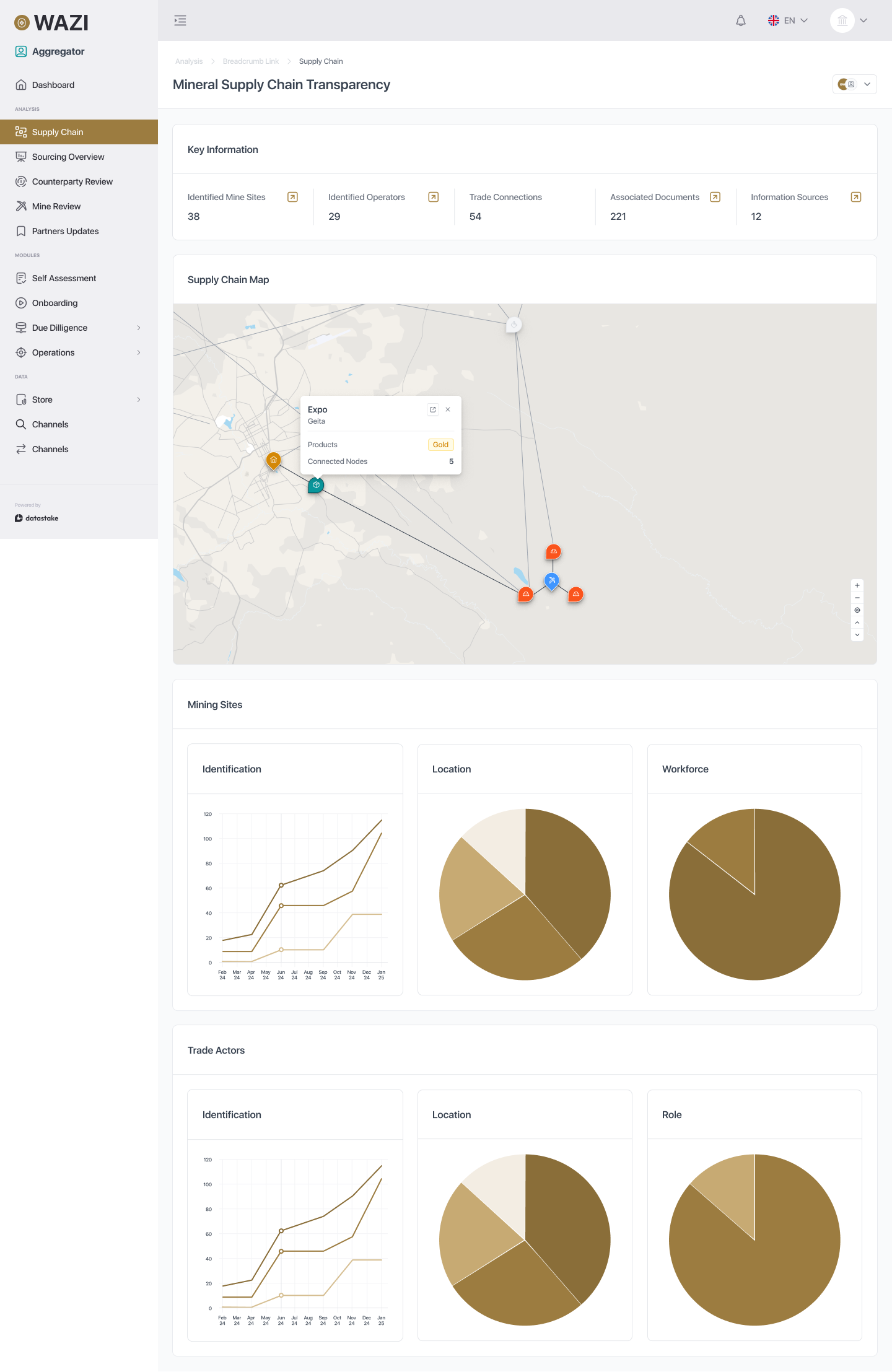
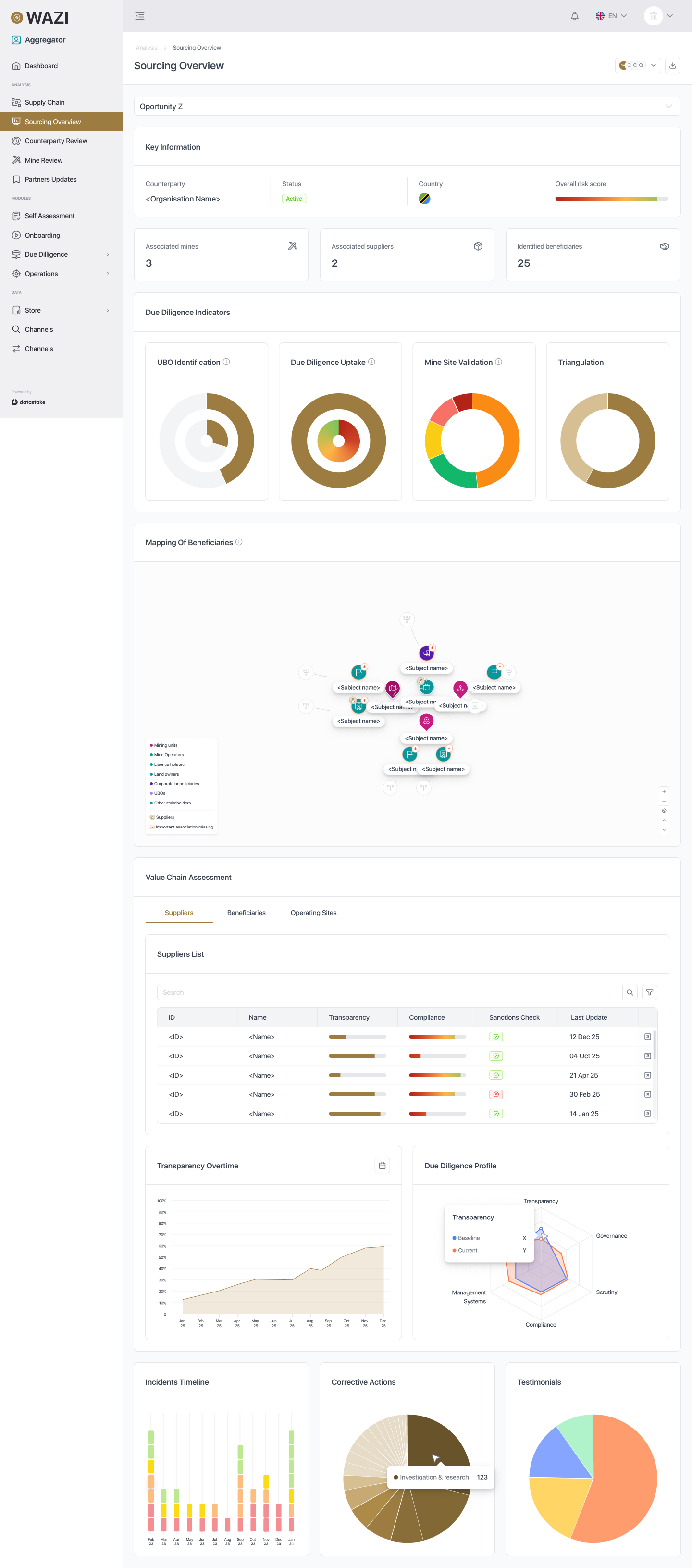
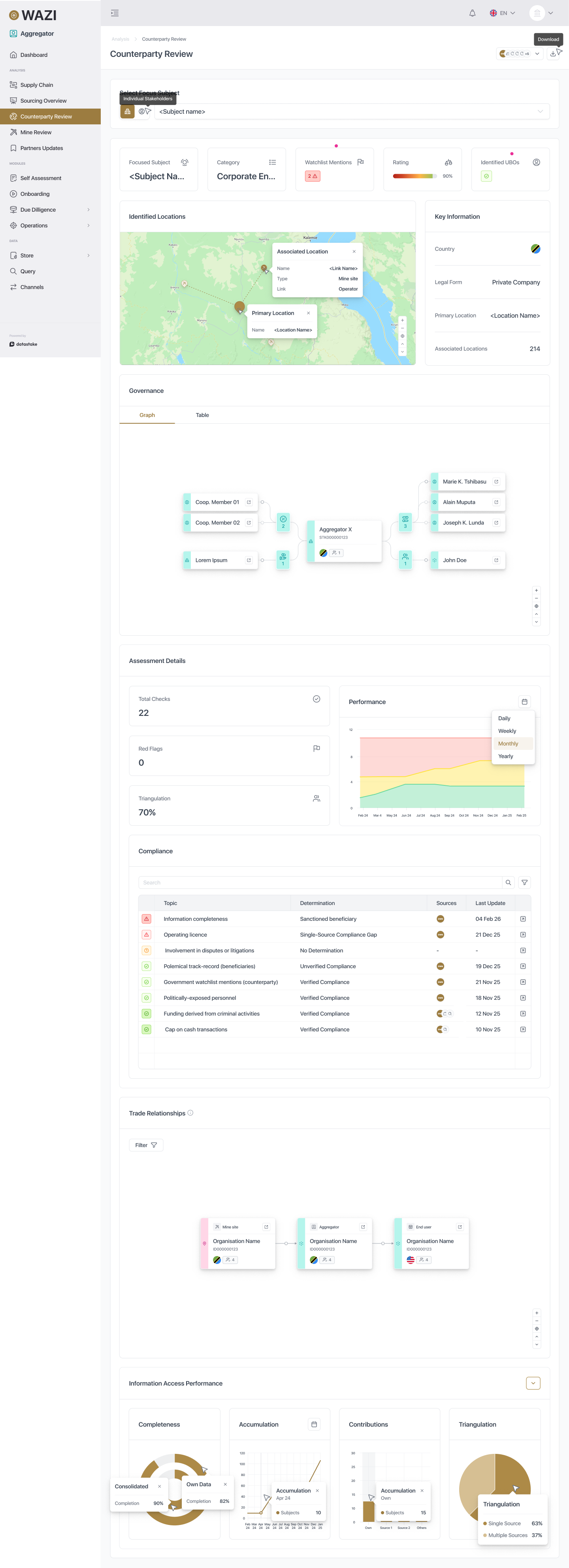
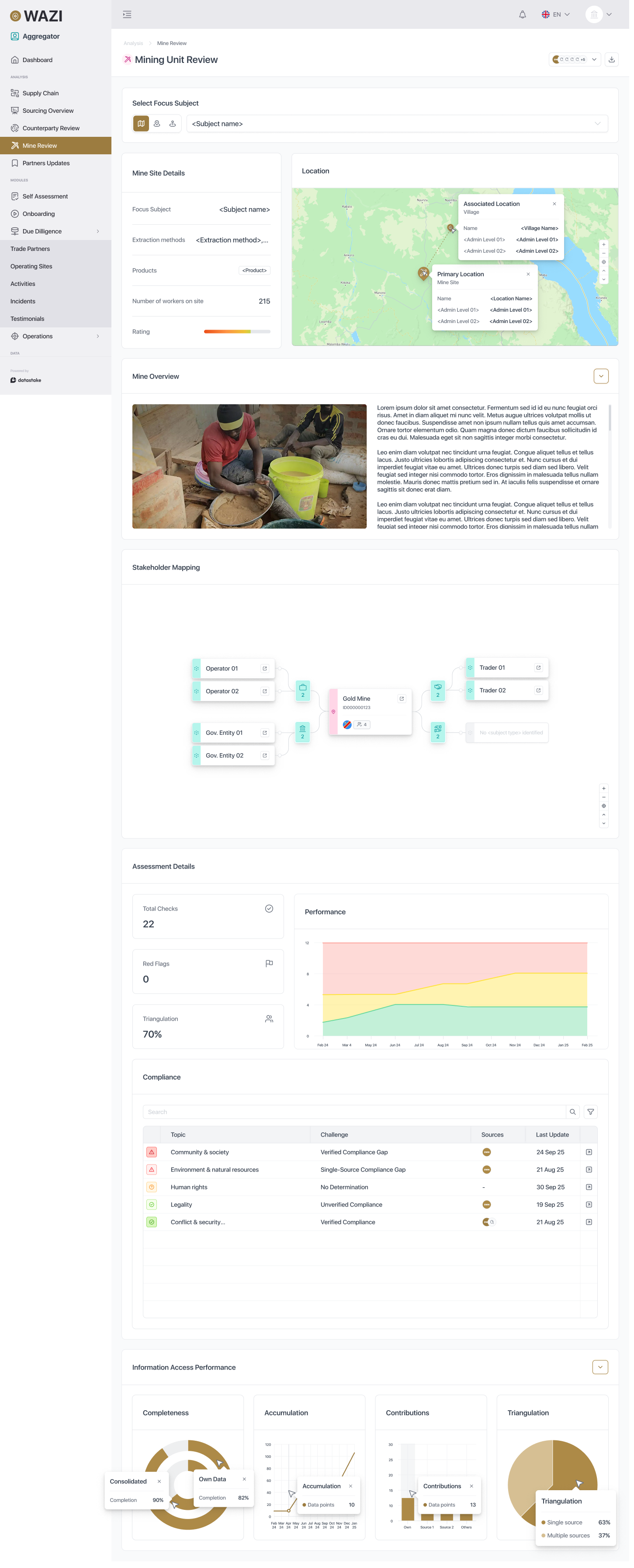
Reporting approach. In WAZI, reporting is not a separate or retrospective exercise. It is the direct output of the system, built progressively through the different modules. Two reporting approaches are supported:
Value chain-based reporting enables aggregators to present clear sourcing opportunities to buyers. Rather than sharing fragmented or partial information, aggregators provide a consolidated view of a Supply Profile including mining sites, counterparties, suppliers, beneficiary and ownership structures, and initial due diligence outcomes. This supports more efficient onboarding of ASM supply chains by buyers and refiners.
Shipment-centric reporting reflects actual sourcing transactions once a relationship is established. Each Shipment Summary serves as the operational and reporting interface between aggregator and buyer, individually linked to its Supply Profile and contextualised within its full value chain. For each shipment, WAZI communicates transaction characteristics, the associated value chain structure, and the due diligence status of relevant actors and locations. This approach supports continuous due diligence, allowing buyers to move from one-off validation to ongoing risk management and engagement.
Reports can be shared with partners through channels or exported for internal use.
Due Diligence Completion. Reporting to clients represents the final stage in the due diligence cycle. At this stage, supply chains have been mapped, actors and locations have been assessed, developments have been documented over time, and sourcing activities have been recorded. These elements are consolidated into structured outputs that are ready for review, audit, and communication. In this way, reporting is not an additional burden, but the natural outcome of a system in which due diligence and operations are already organised.
By structuring reporting in this way, WAZI enables greater transparency across ASM supply chains, more consistent and comparable disclosure, reduced administrative effort in reporting processes, and increased confidence from buyers and partners.
Ultimately, WAZI transforms reporting from a manual and fragmented obligation into a system-driven output, grounded in continuously maintained and digitised information.
5.5.2 Interfaces Beyond the Aggregator
The Operator Interface is in active development (on dev), following the Aggregator MVP; the Partner interface follows. Monitor, Coordinator, and Implementer interfaces are planned for subsequent phases. Each represents a distinct value proposition.
Operator Interface. Structured pathway for upstream counterparties — Mine Operators, Mine Title Holders, Land Owners, and forthcoming material-supplying counterparties (Traders, intermediate handlers) — to build and maintain verifiable profiles. Same KYC and Management Systems forms as the Aggregator Self-Assessment, scoped to the operator's own organisation and operated / titled / owned locations. The interface supports invitation-based registration from a paired Aggregator (Mwamba at MVP), structured self-assessment using the same algorithmic methodology applied by the Aggregator, multi-Aggregator Channel sharing of a single verified profile, response to data requests, and a self-derived posture view (own completion, own algorithmic score on submitted data, own linked Locations and Events). The interface deliberately does not surface Aggregator-side scores or composite Supply Profile evaluations: the operator sees its own data and what falls out of that data, not the Aggregator's internal risk view. The Operator Interface transforms compliance from a burden imposed by buyers into a portable, reusable asset owned by the operator. Unlike a gated application flow, the WAZI Operator Interface renders in full from first login; its module set mirrors the Aggregator Interface except that an Applications module replaces Onboarding (the surface through which the operator applies for onboarding by an Aggregator).
Partner Interface. Read-only downstream interface for buyers of material from the Aggregator. Partners receive access at the Aggregator's discretion on a per-Shipment basis via Channel; no self-onboarding into Aggregator data. Partner activity is limited to receiving Disclosure Packages, navigating their contents (Shipment / Supply Profile / Suppliers / Locations / Events), marking Acceptance per Shipment, and consulting accumulated reporting across received Shipments. The interface carries no compilation surface: Partners do not build profiles, run assessments, or onboard supply chains within WAZI. The Partner Interface complements rather than replaces independent audit: it gives the receiving refiner a structured evidentiary base for its own due diligence and for any audit conducted on top of that due diligence.
Buyer-side shipment review. When an Aggregator shares an Outbound shipment via Channel, the Buyer's account receives a notification and the shipment surfaces in the Buyer's Shipments view, symmetric to the Aggregator's Outbound list. Opening a shipment loads the Disclosure Package (§5.5.2.1). The Buyer marks each shipment Accepted or Not Accepted, with an optional note. Acceptance is recorded with timestamp and surfaced to the Aggregator in the share audit trail. The Buyer may revise the acceptance state by recording a new acceptance event; history is preserved. WAZI does not host an in-app dispute or correction mechanism at MVP. Discussion takes place offline, and any package correction requires the Aggregator to re-share with an updated snapshot.
Monitor Interface (planned). Tools for civil society, government agencies, independent observers, and local consultants to submit linked events, access supply profile context, and contribute independent verification. Monitor data adds a third verification source to the system, increasing confidence in scoring outcomes.
Coordinator and Implementer Interfaces (planned). Tools for international consultants, initiatives, certification programmes, and capacity-building partners to oversee multi-stakeholder programmes and deliver assessments.
5.5.2.1 The Disclosure Package
The Disclosure Package is the unit of information disclosed to a Partner per Outbound Shipment. It is generated at Shipment confirmation, snapshotted, and delivered through a Channel (or, secondarily, exported as PDF or structured data).
Contents.
| Layer | Records included |
|---|---|
| Shipment | Date, weight, purity, destination Buyer, source declaration per declared Supplier (binary in / out), Aggregator self-assessment indicators at confirmation time (KYC + Management Systems Readiness) |
| Supply Profile context | For each declared Supplier: the Supply Profiles in which the Supplier appears, including governance counterparties (Operator, Title Holder, Land Owner), Mines, Beneficiaries and UBO chains, mapping coverage indicators |
| Suppliers | Full KYC and assessment scores for each declared Supplier (Stakeholder algorithmic score, Documentation Completeness, Management Systems Readiness where applicable, red flags) |
| Locations | Mining Units, Processing Plants, and Other Locations associated with each declared Supplier through approved Supply Profiles, with their Location assessment scores across the seven domains (Identification + six OECD Annex II), red flags, and information access performance |
| Events | Incidents, Activities, and Testimonials linked to any Subject in the package, with severity classification, dates, and supporting documentation |
Snapshot semantics. The package reflects the state of every constituent Subject at the moment of Shipment confirmation. Subsequent edits upstream (KYC updates, new Events, new Locations) do not alter previously delivered packages. The Aggregator may re-share an updated package as a new disclosure event; both versions persist in the audit trail.
Relationship to refiner audit. The package is structured to function as the evidentiary base a receiving refiner can hand to its own auditor (OECD Step 4, LBMA Independent Audit). Every score is traceable to underlying criteria, every Subject to its source data, every Event to its provenance. Where audit is still required, the package shortens the auditor's path; where continuous monitoring reduces the marginal value of audit, the package documents the monitoring discipline.
Acceptance protocol. The Partner marks each Shipment Accepted or Not Accepted, with optional note. Acceptance is timestamped and surfaced to the Aggregator. Revisions are recorded as new acceptance events; history is preserved. Disputes and corrections are handled offline; in-app corrections require re-share with an updated snapshot.
5.5.3 Digital Ecosystem Infrastructure
WAZI is designed not only as a due diligence application, but as scalable digital infrastructure for responsible sourcing. Rather than functioning as a closed or standalone tool, WAZI is built to support long-term growth in participation, functionality, and interoperability.
Scalability and sustainability principles. The platform architecture is governed by five principles:
Modular growth of interfaces and workflows. The current Aggregator-focused MVP can progressively expand into a broader multi-user system with upstream Operator interfaces and downstream Partner interfaces, without requiring the application to be rebuilt.
Distributed data custody. Information remains under the control of the user who creates or manages it. This enables wider participation because users are not expected to hand over information into a centralised repository detached from their own control.
Structured and reusable data. WAZI is built around granular information rather than one-off documents. Data entered in one context can be reused across others: self-assessment, onboarding, due diligence, operations, reporting, buyer engagement, programme monitoring, banking relationships, or future regulatory communication.
Interoperability across actors and applications. As the system evolves, users can enrich their due diligence processes not only with directly compiled data, but with relevant information generated elsewhere in the ecosystem: field observations, programme-level data, or information relevant to financing and formalisation processes.
Progressive accumulation of digital value. Each use of WAZI contributes to a growing body of structured data. Over time, users build a persistent digital record of supply chain relationships, due diligence history, operational activities, and reporting outputs. This accumulated information becomes increasingly valuable for both internal management and external engagement.
Core system functionalities. These principles are operationalised through three system functionalities:
Store. The environment in which each user accumulates and manages commoditised information generated through use of WAZI. It enables users to reuse information across workflows, reduce duplication of reporting effort, maintain continuity in due diligence and operations, and progressively build a stronger digital profile within the ecosystem.
Query. Enables users to search for and identify relevant information across the wider ecosystem, subject to access and sharing conditions. Users can progressively enrich their own records by finding existing stakeholders, mine sites, linked supply chain actors, and additional contextual information relevant to due diligence. As interoperability expands, Query can also support discovery of information generated through other applications and user groups.
Exchange via Channels. Controlled, relationship-based data sharing between parties. Channels allow users to define data-sharing relationships and tailor what is made visible to whom. This is especially important in WAZI, where different partners may require different forms or levels of disclosure.
The platform is designed for interoperability. Third-party integrations under consideration include traceability and product passport services, field data collection tools with offline capabilities, and GIS/satellite data feeds for triangulation.
5.5.4 Scalability
WAZI is designed for expansion beyond a single aggregator:
Multi-aggregator operation. Multiple aggregators operating independently within the same system, each with isolated data and independent supply chain management. Shared upstream operators benefit from a single self-assessment that serves multiple relationships.
Geographic expansion. The platform supports multi-language interfaces (English and French at MVP; Portuguese, Swahili, Arabic planned) and can be configured for different jurisdictional requirements.
Regulatory alignment. WAZI's structured data model supports alignment with multiple compliance frameworks. Appendix 06 of the WAZI Application Documentation details alignment with LBMA's Responsible Gold Guidance across management systems (Step 1), risk assessment (Step 2), risk management (Step 3), record keeping and auditability (Step 5), and reporting to clients and stakeholders.
5.5.5 User Interface Conventions
WAZI ships with a set of locked UI conventions, captured at the framework level in (the framework primitive) and instantiated app-wide. Three are load-bearing for v0.7:
Sidebar information architecture (five-seam). Dashboard (top); Modules (My Organisation, Supply Chain, Due Diligence, Operations); Analysis (Sourcing Overview, Counterparty Review, Site Review); Data (Store, Query, Channels). The Data section is a forward placeholder for the DAAC suite — Store, Query, and Channels render in the sidebar but their full functionality is delivered through subsequent DAAC integration. The reframe consolidates module-level navigation ("what the user does") and analysis surfaces ("what the user reads") and separates them from the data-infrastructure surfaces ("what the system holds"). See 2026-05-18 — Sidebar reframe: five-seam structure (Dashboard, Modules, Analysis, Data).
Page header and subheader pattern. Every page renders an H1 paired with a one-sentence subheader. The H1 names what the user does on the page (action verb where the page is a workflow surface, conventional noun where it is an analysis or register surface). The subheader names the utility — the decision the page supports or the work it saves — not the contents (the user already sees those). The Query page (H1 "Find Information"; subheader "Identify available information sources among users of compatible applications and connected databases.") is the canonical reference. Tenant identity renders as a top-bar chip, not in the page H1, except on the Dashboard where the tenant prefix remains as part of the Dashboard's role as the tenant snapshot.
Form design language. Visual tokens, completion-bar rendering, sidebar active state, field row layout (two-zone — main on the left, meta and row-actions on the right), info icon, open-in-form icon, and the Source-Pointer pattern (see §5.1.8) are governed by . WAZI does not override these tokens. The Attestations and Compliance Checks forms in §5.1.8 follow the convention directly; existing KYC, Management Systems, Mine Site, and operational forms align to it on subsequent passes.
6. Compliance Framework Alignment
WAZI is built around the structure of internationally recognised due diligence frameworks. The platform's modules map directly to the OECD Due Diligence Guidance for Responsible Supply Chains of Minerals from Conflict-Affected and High-Risk Areas:
| OECD Step | Description | WAZI Module |
|---|---|---|
| Step 1 | Establish strong company management systems | Self-Assessment |
| Step 2 | Identify and assess risks in the supply chain | Onboarding + Stakeholder and Mine Site Assessments |
| Step 3 | Design and implement a strategy to respond to identified risks | Events Reporting + Continuous Monitoring |
| Step 4 | Carry out independent third-party audit of supply chain due diligence | Consolidated structured data, versioned and linked across subjects and shipments, audit-ready |
| Step 5 | Report annually on supply chain due diligence | Shipment-centric reporting and channel-based disclosure |
LBMA Responsible Gold Guidance is supported in parallel, with WAZI directly addressing LBMA expectations on management systems documentation, factual risk assessment, ongoing risk mitigation, audit trails, and downstream disclosure through shipment-level reporting.
7. Key Capabilities
Algorithmic, transparent assessment. Every score in WAZI is derived from structured data through explicit, documented methodologies. There is no black box. Aggregators, operators, and partners can see exactly which criteria contributed to a score and what evidence supports each determination. This makes assessments auditable, reproducible, and defensible.
Progressive engagement model. WAZI is designed so that doing more work never makes things worse. Mapping more of a supply chain cannot lower a score. Identifying more beneficiaries increases coverage rather than introducing risk. Operators who invest in building their profiles benefit across all their supply chain relationships. This creates a natural incentive loop where engagement deepens over time.
Multi-source verification. The three-phase operational model (aggregator compiles, operators register, monitors observe) creates overlapping verification opportunities. As more sources contribute information about the same subject, consolidation states move from "Unverified" towards "Verified", strengthening confidence in scoring outcomes. The system tracks verification status explicitly, so users always know the basis for each determination.
Guided self-assessment. International standards like the OECD Due Diligence Guidance are complex and abstract. WAZI translates them into structured, form-based assessments that upstream operators can complete directly, using language and workflows designed for the ASGM context rather than the boardroom. This makes standards actionable for the people who actually need to implement them.
Shipment-centric compliance. Every shipment in WAZI is linked to its entire upstream provenance: the supply profile that maps the value chain, the assessments conducted on every counterparty and mining site, the events recorded during the sourcing period, and the complete audit trail. This means compliance documentation is generated from system data, not reconstructed from memory after the fact.
Data sovereignty. Every organisation on WAZI controls its own data. Operators own their self-assessments. Aggregators own their supply chain documentation. Partners receive only what is explicitly shared with them. No organisation is forced to store sensitive information in a central database, and no organisation can access another's data without explicit, revocable permission.
8. Dashboards
WAZI's built-in analysis tools provide Aggregators with structured views of the information compiled across the system, enabling both operational oversight and due diligence management. While data is created and subjects may be individually assessed in Modules, the Analysis layer focuses on how this information is accessed, interpreted, and used for decision-making. These tools serve three primary functions: navigation (allowing users to access key modules and information quickly), oversight (providing consolidated views of supply chains, stakeholders, and activities), and decision support (enabling evaluation of sourcing opportunities and risk exposure).
Aggregator Dashboard
The Dashboard is the central entry point of the Aggregator interface, providing a consolidated overview of system activity, key metrics, and access to core functionalities. It supports operational management (through high-level indicators and activity tracking) and system navigation (through direct access to frequently used actions and modules).
Key components.
- Quick-action buttons provide direct access to frequently used workflows: Self-Assessment, counterparty onboarding, activity and incident reporting, and information search (Query).
- Key Information displays aggregated metrics reflecting the current state of the system: number of monitored locations, identified stakeholders, recorded corrective actions, reported incidents, and information sources. Metrics are aggregated from both Own Data and Partners Data.
- Latest Updates lists recent system activities: document uploads, form updates, subject creation (counterparty, mine site, processing plant, incident, activity, testimonial, shipment), supply profile creation, and status changes. Automated from account activity.
- Monitoring Map provides a geographic visualisation of Locations, Stakeholders, and Events. Aggregated from Own Data and Partners Data, with filtering by source.
- Trade Relationships displays the Aggregator's supply chain per KYC data: the Aggregator (Account) is systematically featured; tier-1 suppliers, mines of direct procurement and clients come from the Trade section of the KYC form; supplier's suppliers, supplier's mines and client's clients come from their respective subject forms; supplier's operated mines come from the Operations section of their respective subject form. Supplier's other clients and clients' other suppliers are not displayed.
- Supply Risk Distribution is aggregated from Approved Supply Profiles.
- Supplier Onboarding reflects the count of Suppliers in KYC (Trade section) over time.
- Events Timeline reflects the count of events per period, organised into: minor incidents (yellow), moderate incidents (orange), major incidents (red), activities (blue), and corrective actions (green).
- Data Compilation is a standard component filtered by number of subjects / data points, covering Accumulation (data over time), Contributions (by users on this Account), and Information Sharing (share of data "published" and shared with pre-identified parties).
Widget behaviour. Each widget reflects the current state of underlying records and updates dynamically as new data is introduced. If no data exists, widgets display empty or default states. The Dashboard is implemented as a pure aggregation layer with no business logic beyond data retrieval and formatting; each widget maps to a defined query or endpoint and is independently refreshable.
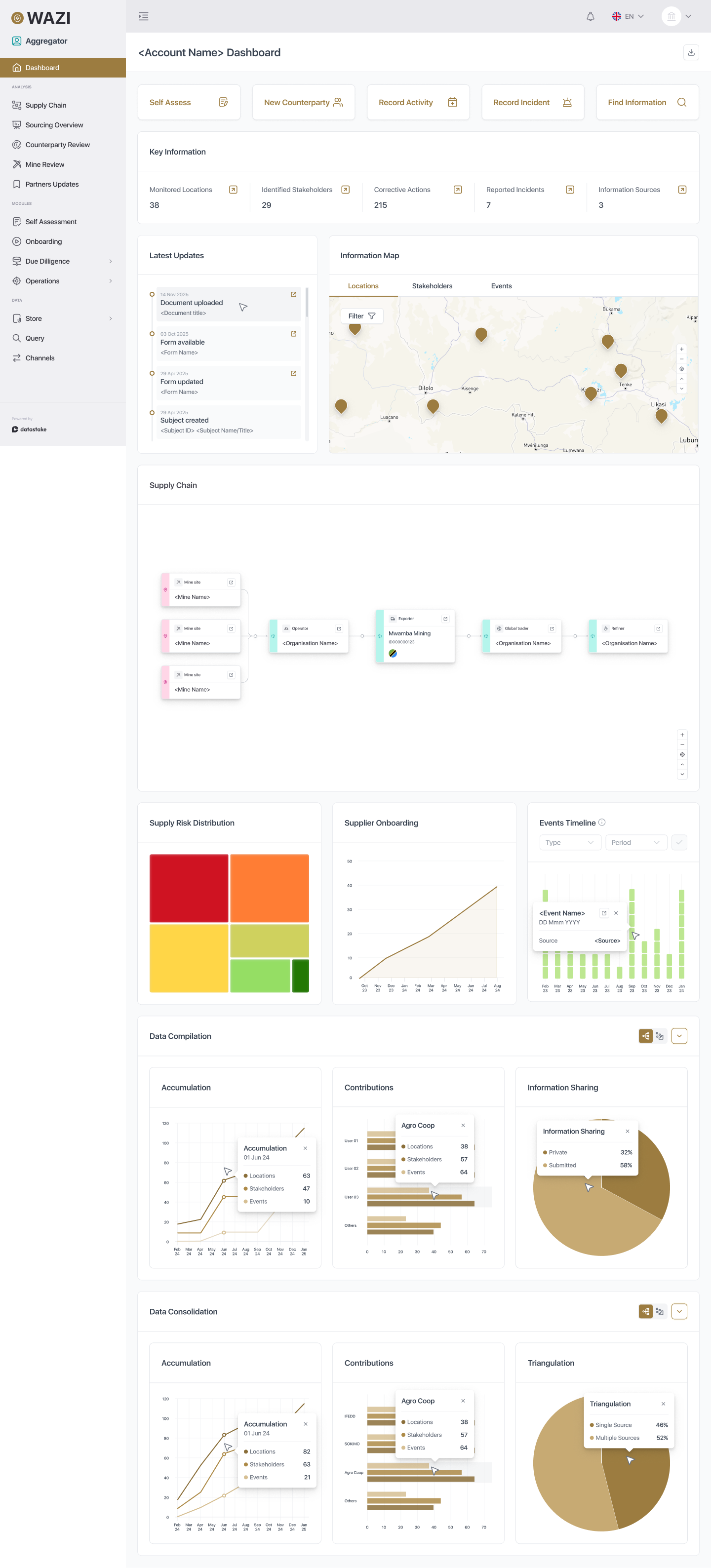
Supply Chain
A visual representation of trade relationships captured within the system, translating structured data into a geographic view. Aggregates relationship data recorded by WAZI account users (or shared by other users), including links between mine sites and operators, commercial relationships between suppliers, traders, and buyers, and connections between stakeholders and locations. Displayed on an interactive map where nodes represent locations or stakeholders and connections represent recorded relationships or flows of material. Users can explore individual nodes to access summary information (associated entities, number of connections, product types).
The Supply Chain view does not introduce new data or assessment logic. It provides a visual exploration layer on top of existing information compiled through Onboarding and Due Diligence — best understood as a visual exploration tool rather than a primary due diligence component.
Sourcing Overview
The primary interface for value chain-level analysis. Built around a supply profile selector that allows users to navigate across existing profiles, load the corresponding Supply Profile Summary, and compare sourcing opportunities. For each selected profile, displays key information (snapshot, associated mines, suppliers, beneficiaries, status, risk score), due diligence indicators (completeness, UBO identification, mine site validation, triangulation), beneficiary mapping, and value chain assessment with dynamic visualisations.
Counterparty Review
A detailed view of individual stakeholders. Consolidates headline information and indicators, associated locations, governance and ownership visualisation, assessment details (criteria, red flags, compliance analysis), trade relationships positioning, and information access performance (completeness, accumulation over time, contribution sources, triangulation level).
Site Review
A detailed view of individual sites — Mining Units, Processing Plants, and Other Locations. Consolidates site details (extraction method or processing technology, product type, workforce size, overall score), geographic position, qualitative site overview, stakeholder mapping (operators, authorities, traders), assessment details (criteria differ by site category), and information access performance.
Operator Dashboard (Planned)
The Operator's landing page consolidates the operator's own posture and its relationship with paired Aggregator(s). It deliberately stays on the operator's side of the data boundary: the operator sees its own completion, its own self-derived score, and what it has shared, not the Aggregator's internal scoring or composite views.
- Profile completeness. KYC and Management Systems completion percentage, with surfaced gap fields.
- Self-derived score. Algorithmic score computed on the operator's submitted data, using the same methodology applied by the Aggregator. Shown for the operator's own benefit; informational, not a window into the Aggregator's risk view.
- Pending requests. Data requests issued by paired Aggregators (Mwamba and future others), with status (open / responded / overdue).
- Linked Locations. Mining Units, Processing Plants, and Other Locations the operator operates, holds title to, or owns, with completion status per Location.
- Channels. Active Channels with each paired Aggregator and the disclosure scope under each.
- Events affecting the operator. Incidents, Activities, and Testimonials linked to the operator or to its Locations, where the operator is itself the recorder or where an event has been shared with it.
Partner Dashboard (Planned)
The Partner's landing page consolidates received Disclosure Packages across all Aggregators sharing into the Partner Account.
- Shipments received. Table of all Shipments shared with the Partner, with date, originating Aggregator, declared Suppliers, weight, purity, and Acceptance status.
- Pending acceptance. Shipments awaiting Accept / Not Accept decision.
- Portfolio risk distribution. Aggregated risk band distribution across received Supply Profiles (Clear / Manageable / Elevated Risk / Red Flag Active).
- Active Channels. List of Aggregators sharing with the Partner, and the scope of each Channel.
- Audit pack export. Single-click export of the full set of Disclosure Packages received in a given period, structured for handover to the Partner's auditor.
9. Extensions and Roadmap
The following capabilities are planned beyond the current MVP scope. Each is described with enough context to evaluate its priority.
Monitor Interface and Workflows. Independent field observers, civil society organisations, and community representatives submit linked events and observations. Monitor data creates a third verification source, strengthening scoring confidence and enabling triangulated risk assessment.
Coordinator and Implementer Tools. Technical partners and capacity-building organisations manage workshops, track onboarding progress, deliver assessments, and support operator adoption. Coordinators (e.g. LBMA, certification bodies) oversee multi-stakeholder programmes and may access dedicated compliance reporting interfaces.
Advanced Scoring and Pattern Detection. Machine learning-enabled risk prediction, anomaly detection across supply chains, and incident clustering to identify systemic risks. This extends the current algorithmic model with predictive capabilities.
Beneficiary Verification Integration. API connections to company registries, sanctions databases, and politically exposed persons (PEP) lists for automated UBO cross-checking and screening.
Offline Mode. Operators and monitors in low-connectivity ASGM areas can work offline and synchronise when connectivity is restored. Field data collection may leverage third-party tools with proven offline capabilities.
Mobile Applications. Native iOS and Android applications for event reporting, self-assessment completion, and status checking in the field.
Multi-Language Expansion. Portuguese, Swahili, and Arabic interfaces beyond the current English and French support.
DAAC Exchange Protocol. A cross-platform data exchange protocol enabling WAZI to share curated supply chain data with other due diligence systems and partner platforms. Operators documented in WAZI would carry their verified profiles across any platform in the ecosystem.
10. Open Questions
The following items require client input to finalise. They are grouped by theme.
Scoring and Thresholds.
- Are the current risk classification thresholds (Low Risk ≥ 75, Moderate 50–74, High Risk < 50) aligned with Mwamba's operational decision-making?
- Should supply profile classification drive automated workflow restrictions (e.g. preventing shipment creation for Elevated Risk profiles), or remain advisory?
- Is the current red flag list (sanctions, watchlists, international reports, criminal funding for stakeholders; forced labour, child labour, armed group involvement, conflict financing, illegal taxation for locations) complete for Mwamba's compliance obligations?
Operations and Traceability.
- What level of production recording granularity is required at MVP (daily, weekly, per-shipment)?
- How should inventory reconciliation work between mine site and processing plant? Is loss tracking at each stage needed at MVP?
- Cross-stage plausibility coherence. WAZI does not enforce reconciliation across the four operational record types at MVP: mining production (W14 Mining), inbound shipments (W10), processing output (W14 Processing), and outbound shipments (W11). Should plausibility checks be introduced (mining vs inbound, inbound vs processing output, processing vs outbound)? If so, what tolerance bands, and how should flags be surfaced (advisory only, gate the next workflow, alert)?
Stakeholder Engagement.
- What is the trigger for inviting an operator to register and self-assess? Is it tied to supply profile creation, or managed independently?
- For partners, what level of disclosure should be configurable when a channel is created?
- Are custom roles (Reviewer, module-specific permissions) needed at MVP, or can they follow in a subsequent release?
11. Next Steps
- Methodology review: walk through scoring logic and classification thresholds with the Mwamba team.
- Configuration alignment: translate locked specification decisions into system configuration.
- QA and deployment cycle for resolved items.
Glossary
| Term | Definition |
|---|---|
| Aggregator | Central coordinator role. Typically an exporter, cooperative, or development organisation managing sourcing relationships and due diligence. |
| ASM / ASGM | Artisanal and Small-Scale (Gold) Mining. Mining operations using simple equipment and methods, often informal or semi-formal. |
| Beneficiary | Entity with economic interest in a counterparty or mining operation. May be a natural person or corporate entity. |
| Channel | Controlled data-sharing relationship between accounts, enabling selective disclosure without central data storage. |
| Consolidation State | One of seven verification statuses (Verified Compliance through Verified Gap) reflecting the confidence level of a data point based on its source and verification history. |
| Counterparty | Stakeholder with governance or operational responsibility over a mining location. Includes mine operator, titleholder, and landowner roles. |
| Disclosure Package | Read-only snapshot bundle delivered to a Partner per Outbound Shipment. Contains the Shipment record, originating Supply Profile context, declared Suppliers' KYC, associated Locations, and linked Events, frozen at Shipment confirmation. The unit of partner-facing disclosure. See §5.5.2.1. |
| Due Diligence (DD) | Systematic evaluation of supply chain actors and locations against defined criteria covering legality, human rights, environment, health and safety, community, and conflict. |
| Entry Point | The initial subject (mine site or counterparty) that introduces a supply opportunity to an aggregator. |
| Event | Recorded incident, activity, or testimonial relevant to supply chain integrity. Events are standalone subjects linkable to any entity. |
| Governance Link | Counterparty-to-Mine relationship where the Counterparty holds a legal or operational role over the Mine: Operator, Titleholder, or Landowner. |
| KYC | Know Your Customer. Structured organisational identity and governance information compiled through self-assessment forms. |
| Land Owner | Counterparty role: legal owner of the land on which a Mining Unit operates. One of three governance roles WAZI tracks per Mine, alongside Operator and Title Holder. |
| Mines of Origin | Transaction-specific subset of a Supplier's Mines of Procurement, confirmed by the aggregator during Inbound shipment creation. |
| Mines of Procurement | Aggregate of all mines linked to a Supplier via approved Supply Profiles, as surfaced in the aggregator's KYC Trade / Supply section. |
| Mining Unit | Discrete geographic location where extraction or beneficiation occurs. May be a formal concession or informal artisanal site. |
| Operator | Upstream supply source. Mine site operator, mining company, cooperative, or counterparty providing gold. |
| Partner | Downstream user. Refiner, buyer, or certification programme accessing disclosed supply chain information via channel. |
| Procurement Link | Counterparty-to-Mine relationship where the Counterparty sources gold directly from the Mine without holding a governance role. Role attribute: Procurer. Captures traders, cooperatives, and buying agents that aggregate material from mines they do not operate. |
| Red Flag | Binary indicator of a critical compliance concern that overrides score-based classification, regardless of composite score. |
| Scoring | Algorithmic translation of structured assessment data into quantitative risk indicators (0–100 scale). |
| Self-Assessment | Structured questionnaire covering organisational KYC and management system maturity, completed by the account holder about their own organisation. |
| Shipment | Discrete sourcing transaction. WAZI distinguishes Inbound Shipments (gold received from a Supplier, anchored on the Supplier) and Outbound Shipments (gold dispatched to a Buyer, anchored on the Buyer with a declared set of Suppliers whose combined Supply Chain and Supply Profile context forms the disclosure). Each type has a distinct workflow and reporting purpose. |
| Stakeholder Assessment | Evaluation of a counterparty against governance, compliance, and financial integrity criteria using entity-intrinsic data. |
| Subject | Any identifiable entity in WAZI: person, organisation, location, event, or document. |
| Supplier | A counterparty that physically introduces gold into the aggregator's chain of custody. Designated within a supply profile via the Supplier Toggle. |
| Supply Profile | Structured representation of a single sourcing opportunity, mapping the upstream value chain including counterparties, beneficiaries, mining units, and designated supplier. |
| Title Holder | Counterparty role: holder of the legal title (concession, permit, or equivalent) authorising mineral extraction at a Mining Unit. One of three governance roles WAZI tracks per Mine, alongside Operator and Land Owner. |
| UBO | Ultimate Beneficial Owner. The natural person(s) with final economic interest in a counterparty. |
Appendices
Appendix A — LBMA Responsible Gold Guidance Alignment
WAZI's modules align with the five-step structure of the LBMA Responsible Gold Guidance.
Management Systems (LBMA Step 1). Structured Self-Assessment module; documentation of policies, internal controls, risk management procedures; clear linkage between organisational profile and due diligence outputs. WAZI directly supports LBMA expectations on internal systems and governance documentation.
Risk Assessment (LBMA Step 2). Onboarding and Assessments create structured mapping of supply chains and consistent evaluation of counterparties and mine sites, supported by the use of risk indicators and scoring. WAZI aligns with LBMA's requirement to identify and assess risks in the supply chain based on factual information.
Risk Management (LBMA Step 3). The Monitoring module (Events) captures incidents, corrective actions, and stakeholder feedback. Continuous updates to assessments and profiles support ongoing risk mitigation and documentation of actions taken.
Independent Audit (LBMA Step 4). WAZI does not conduct audits, but supports audit readiness by structuring information for external review. All assessments, scoring inputs, source attribution, and supporting documentation are accessible from a single value chain view.
Record Keeping and Auditability (LBMA Step 5). All data is structured, versioned, and linked across entities and shipments, providing full traceability of decisions, updates, and reported information. WAZI is naturally strong on audit trails, which is critical to LBMA compliance.
Reporting to Clients and Stakeholders. Shipment-level reporting includes value chain composition, risk assessments, and mitigation evidence. WAZI supports LBMA expectations on transparency and downstream disclosure.
Appendix B — Other System Functionalities
Administrative Panel.
- Admin privileges (MVP): account-level configuration, user management, and access control.
- Subject management (merge / delete / edit core Subject data) is App Administrator-only, due to subject-recognition and linking risks. Standard users cannot perform these operations.
- Potential expansion: programme-level oversight, multi-account orchestration.
Account and User Management.
- Account creation and registration.
- Role-based access control (Aggregator roles: Admin, Editor, Viewer; Operator and Partner roles defined per interface).
- Password recovery.
Data Compilation and Handling.
- Form Structure: progressive disclosure, sectioning, and conditional fields driven by the the configuration layer.
- Input Types: structured fields, document attachments, subject linking, geospatial inputs.
- Subject Linking: the mechanism by which any field referencing a person, organisation, location, event, or document creates or links to a Subject record (rather than free-text capture).
- Versioning: all records are versioned; historical states are preserved and auditable.
Information Sharing. Channels enable controlled, relationship-based data sharing between accounts. Each Channel defines what is visible to whom, supporting selective disclosure without central data storage.
Notifications. System and user notifications cover form updates, subject creation, shipment events, and channel activity.
Dashboard Updates. The "Latest Updates" widget on the Aggregator Dashboard surfaces recent system activity (form updates, subject creation, status changes, supply profile changes, production records).
Appendix C — Design Notes and Clarifications
Aggregator data sources. Information aggregated on the Dashboard and across analytical widgets is drawn from Own Data and Partners Data. While Partners Data is not immediately relevant at MVP, the architecture accounts for the fact that Aggregators may eventually receive or acquire information from other supply chain stakeholders.
Discovery via Due Diligence vs Self-Assessment. The chain of suppliers and clients derived from direct trade relationships (e.g. suppliers' suppliers) is identified in the Due Diligence module rather than Self-Assessment. This acknowledges that for most ASM buyers, the discovery of upstream supply chain participants and mines of origin is part of ongoing due diligence rather than a one-off self-declaration.
Mine site granularity. Granular separation into shafts or pits facilitates handling of situations where multiple operators are present across one "mine site". Subsequent due diligence activities can thus be assigned at various levels of granularity.
Sole proprietorship for individual operators. Where an individual ASM operator is the de facto operator of a mine site, they are typed as a Sole Proprietorship (Business Entity) rather than as an Individual. This ensures that such individual operator can be appropriately featured in Trade Relationships mapping, where only business entities may be fetched.
Due Diligence module scope. The Due Diligence module is conceived to accommodate existing trade partners (from KYC), potential trade partners (from Supply Profiles), tier-n supply chain connectors identified via Trade Relationships, and any other entity the Aggregator may wish to assess. Likewise for locations: Aggregator-operated sites (from KYC), potential procurement sites (from Supply Profiles), mines of origin identified via Trade Relationships, and any other location the Aggregator may wish to assess.
Algorithmic scoring scope. Algorithmic scoring does not replace field verification or expert review. It structures how information is compiled and evaluated, providing auditors and due diligence practitioners with a clearer and more efficient framework for reviewing ASM supply chains.
Appendix D — Referenced Specifications
The following documents are referenced from this Specification and maintained as separate specs:
- WAZI Algorithmic Stakeholder Evaluation — full criteria, formulas, and methodology for stakeholder-level due diligence assessment.
- WAZI Algorithmic Location Evaluation — full criteria, formulas, and methodology for mine site / location-level due diligence assessment.
- WAZI Stakeholder Scoring Methodology — detailed scoring engine logic for stakeholder assessments (KYC, Documentation, Management Systems tiers).
- WAZI Supply Opportunity Assessment Methodology — detailed scoring engine logic for the two-dimensional Supply Profile composite (Provenance and Custody; Beneficiary Structure and Financial Integrity).
These four documents hold the deep methodological detail. They are not duplicated in this specification. Any methodology change to scoring or evaluation criteria is made there first, then surfaced here as a high-level summary.
Appendix E — Form Catalogue
Single inventory of every form surface in WAZI as of v0.7. Each form has its own workflow (W-series) home. Forms relate to scoring per the v0.7 framing: KYC and Management Systems feed the Stakeholder scoring framework (16 criteria + management systems composite); the Mine Site form feeds the Site scoring framework; Attestations and Compliance Checks are not scored at v1 (see §5.1.8); operational forms (Workforce, Production, Shipments) feed value-chain reporting but are not direct scoring inputs.
| Form | Home | Actor scoping | Workflow | Scoring | Schema home |
|---|---|---|---|---|---|
| KYC | My Organisation > KYC | Aggregator self; Operator self | W3 | Stakeholder Tier 1 (16 criteria) | WAZI Stakeholder Form |
| Management Systems | My Organisation > Management Systems | Aggregator self; Operator self | W4 | Stakeholder Tier 3 (5 forms composite) | Configuration form catalogue (schema TBD) |
| Attestations | My Organisation > Attestations | All actors self | W16 | Not scored at v1 | Configuration form catalogue; string content in the Engineering form-contents workbook |
| Compliance Checks | My Organisation > Compliance Checks | Conditional per Stakeholder typology (Mining / Trading / Processing / Exporting) | W16 | Not scored at v1 | Configuration form catalogue; string content in the Engineering form-contents workbook |
| Stakeholder | Trade Network > Stakeholder | Any subject in the Trade Network | W7 | Stakeholder Tier 1 | WAZI Stakeholder Form |
| Mine Site | Operating Sites > Mine Site | Site (Mining Unit) | W8 | Site Tier 1 (22 criteria across 7 domains) | WAZI Location Form |
| Processing Plant | Operating Sites > Processing Plant | Site (Processing Plant) | W8 (variant) | Site Tier 1 (13 criteria across 6 domains) | WAZI Location Form |
| Other Location | Operating Sites > Other Location | Site (Other Location) | W8 (variant) | Site Tier 1 (10 criteria across 3 domains) | WAZI Location Form |
| Event (Activity / Incident / Testimonial) | Due Diligence > Activities / Incidents / Testimonials | Per-category | W9 | Not scored directly; enriches DD profile | Configuration form catalogue |
| Workforce | Operations > Workforce | Aggregator-led (Operator post-MVP) | W13 | Not scored directly | Configuration form catalogue (schema TBD) |
| Production Record | Operations > Production | Aggregator-led (Operator post-MVP for Mining) | W14 | Not scored directly | form draft in WAZI Configuration |
| Shipment (Inbound / Outbound) | Operations > Shipments | Aggregator | W10 / W11 | Not scored directly | form draft in WAZI Configuration |
| System Registration | Registration wizard | Self at signup | W1 | n/a | form draft in WAZI Configuration |
| Counterparty Quick-Create | Trade Network > Add Counterparty | Aggregator | W7 (entry) | n/a | form draft in WAZI Configuration |
| Site Quick-Create | Operating Sites > Add | Aggregator | W8 (entry) | n/a | form draft in WAZI Configuration |
Document Version: 0.7 | Date: May 2026 | Status: Internal Master Specification (Canonical)
This specification is the canonical, internal master spec for WAZI. Client-facing materials (proposals, walkthroughs, public documentation) are derived from this document. The four scoring methodology documents listed in Appendix D hold the deep methodological detail and are referenced here rather than duplicated.